















 It’s Only Common Sense: Why Should They Take Your Call?
 The Marketing Minute: When Everyone Is a Thought Leader, No One Is
 The Chemical Connection: More Solutions to Common PCB Etching Questions





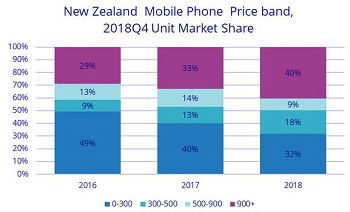
Low end mobile phones are likely to phase out in 2019 as Kiwis are opting for more expensive devices according to IDC's Quarterly Mobile Phone Tracker.
IDC research shows that New Zealanders are opting for higher end devices with greater average selling prices in place of lower end phones. In 2018, Low-End devices declined by 19% year on year (YoY).
In 2017 the low-end segment accounted for 40% of all shipments, in 2018 this decreased to 32% of the market. The lost share has moved up the value chain and into higher end devices. The mid-range shipments increased by 43% annually, and the ultra-high-end has increased by 24%.
Scott Manion, Associate Market Analyst for client devices at IDC New Zealand, says consumers are willing to invest a greater amount in their devices because they’re becoming increasingly reliant upon them in their daily lives.
“Increased reliance on phones are leading to greater willingness to invest on a high-end device which offers better performance in the long run. While vendors benefit from greater revenue in the short-term, these higher-end devices lead to longer life cycles,” says Manion.
Consumers are now holding onto their devices for longer but are willing to spend more when it is time to renew. In 2018, shipments decreased by 1.6% annually, however increasing ASP’s led to a 21.6% increase in revenue. According to IDC's Quarterly Mobile Phone Tracker, consumers usually hold on to smart phones for an average of 3.7 years before acquiring a new unit. This, in combination with a saturated smartphone market are likely the main contributors to decreased unit shipments.
Rising ASP’s in the ultra-high-end space is causing concern for vendors given New Zealand market's price sensitivity. Only a few weeks ago Spark reported difficulty in moving high-end phones, which begs the question "does New Zealand’s smartphone market have a price ceiling?"
“All recent evidence points to yes. The current flagship market doesn’t offer enough marginal benefit to justify the increased price between models for many Kiwis. Consumers are increasingly opting for older models rather than the new flagship. Often these fulfil the use case without breaking the bank,” says Manion.
While consumers are increasing their willingness to spend on devices, this spending has a limit. If mobile manufacturers continue to raise device prices, New Zealand market demand for flagship devices is likely to fall.
IDC divides smartphones into a series of tiers based on price bands. The smartphone tiers are as follows:
- Low end ($0 to <$300)
- Midrange ($300 to <$500)
- High end ($500 to <$900)
- Ultra-high end ($900+)
About IDC
International Data Corporation (IDC) is the premier global provider of market intelligence, advisory services, and events for the information technology, telecommunications, and consumer technology markets. With more than 1,100 analysts worldwide, IDC offers global, regional, and local expertise on technology and industry opportunities and trends in over 110 countries. IDC's analysis and insight helps IT professionals, business executives, and the investment community to make fact-based technology decisions and to achieve their key business objectives. Founded in 1964, IDC is a wholly-owned subsidiary of International Data Group (IDG), the world's leading media, data and marketing services company that activates and engages the most influential technology buyers.


