













 It’s Only Common Sense: How to Demonstrate Grace Under Pressure During Tough Times
 Trouble in Your Tank: Pre-electroless Causes of Voids
 Punching Out: Preparing Your PCB/EMS Business for Sale





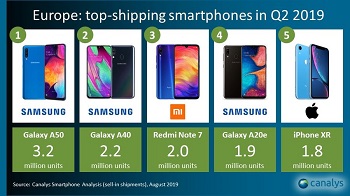
Samsung rocketed to over a 40% market share in Europe in Q2, its highest for five years, as it shipped 18.3 million smartphones. It has brought a blitz of competitive new devices to market, focusing on its A series, which accounted for over 12 million units. Its top four models in this range, the Galaxy A10, A20e, A40 and A50, together shipped more units than any other vendor in Europe managed with their entire range of smartphones. Huawei, its main rival, suffered the impact of political restrictions in the United States, its shipments falling 16% to 8.5 million units. Apple remained the third largest vendor, falling 17% to ship 6.4 million iPhones. Xiaomi took advantage to gain further share in markets where it is strong, growing 48% to 4.3 million units. HMD Global completed the top five, down 18% to ship 1.2 million smartphones.
“Samsung obviously had enough of losing share in Europe,” said Canalys Senior Analyst Ben Stanton. “For years, a focus on operating profit has stifled its product strategy. But this year, the shackles are off, and winning back market share is its clear priority. But its success is not solely due to product strategy. Samsung has been quick to capitalize on Huawei’s US Entity List problems, working behind the scenes to position itself as a stable alternative in conversations with important retailers and operators. A lack of brand loyalty among users of low-end and mid-range Android smartphones, which has blighted Samsung for so long, has become the catalyst for its best performance in years. Europe keeps its reputation as one of the most brand-volatile smartphone markets in the world, rife with danger, but also opportunity.”
“Xiaomi is now a major force in Europe,” said Canalys Analyst Mo Jia. “Its core strength remains price-sensitive countries across Europe, in online and open market channels, but it is increasingly being trusted and ranged by important mobile operators. It is not necessarily in the interests of the channel for Samsung to get stronger. If Samsung consolidates its power against a weakened Huawei, it can negotiate harder on margin. For this reason, distributors, retailers and mobile operators are actively seeking alternative brands to fill the gap and reduce their dependence on Samsung. Xiaomi did not initially find favor with operators in Western Europe, due it its low channel margin structure, but as smaller brands fade away, the appetite to work with Xiaomi is growing. It has also benefited from its early foray into 5G, which is helping foster new operator partnerships while the range of available 5G smartphones is limited.”
About Canalys
Canalys is an independent analyst company that strives to guide clients on the future of the technology industry and to think beyond the business models of the past. We deliver smart market insights to IT, channel and service provider professionals around the world. We stake our reputation on the quality of our data, our innovative use of technology and our high level of customer service.


