















 Flex Connections: Material Selection in Nickel vs. Copper Tabs
 Flex Connections: Four Lessons in Engineering Judgment for PCB Designers
 Flexible Thinking: ‘Let There Be Light’–Emitting Diodes!





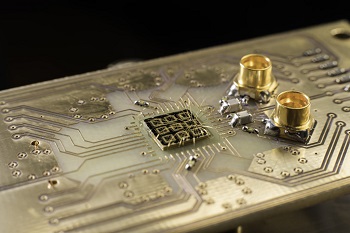
Quantum computing has the potential to revolutionize technology, medicine, and science by providing faster and more efficient processors, sensors, and communication devices. But transferring information and correcting errors within a quantum system remains a challenge to making effective quantum computers.
Image Caption: Thin aluminum wires connect the surface of a quantum processor semiconductor chip to pads on a circuit board. The researchers fabricate the device by patterning and depositing metal gates on a chip. The metal gates are designed to trap individual electrons in the semiconductor. The researchers send electrical signals to the device via the aluminum wires, changing the voltage on the metal gates to control the electrons. They also receive electrical signals from the device to help monitor the electrons’ behavior. (University of Rochester photo / J. Adam Fenster)
In a paper in the journal Nature, researchers from Purdue University and the University of Rochester, including John Nichol, an assistant professor of physics, and Rochester PhD students Yadav P. Kandel and Haifeng Qiao, demonstrate their method of relaying information by transferring the state of electrons. The research brings scientists one step closer to creating fully functional quantum computers and is the latest example of Rochester’s initiative to better understand quantum behavior and develop novel quantum systems. The University recently received a $4 million grant from the Department of Energy to explore quantum materials.
John Nichol and PhD students Yadav Kandel, left, and Haifeng Qiao, right, demonstrated a way to manipulate electrons and transmit information quantum-mechanically, bringing scientists one step closer to creating a fully functional quantum computer. Quantum computers will be able to perform complex calculations, factor extremely large numbers, and simulate the behaviors of atoms and particles at levels that classical computers cannot. (University of Rochester photo / J. Adam Fenster)
Quantum Computers
A quantum computer operates on the principles of quantum mechanics, a unique set of rules that govern at the extremely small scale of atoms and subatomic particles. When dealing with particles at these scales, many of the rules that govern classical physics no longer apply and quantum effects emerge; a quantum computer is able to perform complex calculations, factor extremely large numbers, and simulate the behaviors of atoms and particles at levels that classical computers cannot.
Quantum computers have the potential to provide more insight into principles of physics and chemistry by simulating the behavior of matter at unusual conditions at the molecular level. These simulations could be useful in developing new energy sources and studying the conditions of planets and galaxies or comparing compounds that could lead to new drug therapies.
“You and I are quantum systems. The particles in our body obey quantum physics. But, if you try to compute what happens with all of the atoms in our body, you cannot do it on a regular computer,” Nichol says. “A quantum computer could easily do this.”
Quantum computers could also open doors for faster database searches and cryptography.
“It turns out that almost all of modern cryptography is based on the extreme difficulty for regular computers to factor large numbers,” Nichol says. “Quantum computers can easily factor large numbers and break encryption schemes, so you can imagine why lots of governments are interested in this.”
Page 1 of 2


