








RoboSense Smart LiDAR Sensor Wins the 2020 Edison Awards
April 2, 2020 | RoboSenseEstimated reading time: 2 minutes
RoboSense, the world’s leading autonomous driving LiDAR perception solution provider, has been honored as a winner in Transportation & Logistics Category for 2020 Edison Awards. The Edison Awards is one of the world's prestigious awards that symbolize the persistence and excellence in innovation and honors the most innovative products and business leaders in the world. It was established in 1987 and named after inventor Thomas Alva Edison and sometimes referred to as “The Oscars of Innovation.” All the winners were chosen as the "best of the best" by the global review panel consisting of 3,000 senior business executives and academics.
“We are very proud that our Smart LiDAR Sensor has been recognized by 2020 Edison Awards. It stands for the global industry experts’ recognition of RoboSense product design, development, and production processes and also indicates that RoboSense has achieved a new milestone of complete readiness for mass production of automotive LiDARs. We will continuously improve the product performance for the safety and mass production development of autonomous vehicles,” Dr. Leilei Shinohara, RoboSense Co-partner and Vice President said.
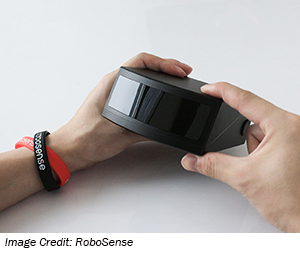
For the environment perception of autonomous driving, the sensor hardware only collects data, thus AI perception algorithms for data analysis are needed to speed up self-driving car’s accurate decision making. The RoboSense “RS-LiDAR-M1” is the world’s first and smallest MEMS Smart LiDAR Sensor to incorporate sensor hardware, AI perception algorithms, and IC chipsets. It transforms overpriced traditional LiDAR systems known as solely information collectors to full data analysis and comprehension systems, providing essential information for the autonomous vehicles to achieve decision-making faster and safer than ever before. For OEMs, the smart LiDAR Sensor with AI perception algorithms inside can also reduce the performance and cost requirements for the domain controller within the vehicle, releasing their R&D investment pressure.
RoboSense MEMS-based LiDAR M1 uses 905nm lasers, boasting low cost, automotive grade, and compact size. Parts have been reduced from hundreds to dozens in comparison to traditional mechanical LiDARs, greatly reducing the cost and shortening production time—achieving a breakthrough in manufacturability. The coin-sized optical module processes the optical-mechanical system results to meet autonomous driving performance and mass production requirements.
In December, RoboSense’s LiDAR production line including RS-LiDAR-M1 has obtained the IATF 16949 certification in the automotive field, which now fully qualifies it to supply to automotive customers. As the winner of the CES Innovation Award in 2019 and 2020, RoboSense RS-LiDAR-M1 also demonstrated that it is the world’s first and only Smart LiDAR capable of real road tests on open roads at CES 2020.
Subscribe
Stay ahead of the technologies shaping the future of electronics with our latest newsletter, Advanced Electronics Packaging Digest. Get expert insights on advanced packaging, materials, and system-level innovation, delivered straight to your inbox.
Subscribe now to stay informed, competitive, and connected.
Suggested Items
TLT Electronics Officially Opens Facility in Vietnam
05/06/2026 | TLT ElectronicsLithuanian EMS provider TLT Electronics has recently announced the opening of a new facility in Vietnam. For their clients, this is a chance to expand manufacturing into a second region without the headache of onboarding a new supplier. Same team, same processes, same quality standards — still TLT Manufacturing, just on another continent.
Learning with Leo: Drones—Meeting Demand Without Compromise
05/06/2026 | Leo Lambert -- Column: Learning With LeoWith drones used in a wide range of applications today, particularly in modern military conflicts, domestic manufacturers are feeling pressure to produce at high volume and low cost, particularly within an NDAA supply chain ecosystem with differing needs and expectations. Two issues must be considered. First is the manufacturers’ and customers’ need for quality, reliability, and functionality of the product. Second is the manufacturing volume needed to support demand, whether for military, industrial, or commercial applications. Each segment requires verification that the product meets the customer's requirements.
EDADOC: Building the ‘Neural Hub’ for High-Compute Chips Within a Compact Space
04/28/2026 | ECIOEvery chip to the market must pass a stringent checkpoint before shipment known as ATE testing. Serving as the physical “neural hub” that connects test equipment worth millions of dollars with the device under test, the performance of the ATE test board directly determines the accuracy, efficiency, and final yield of chip testing. Amid the rapid rise of high-compute chips, what extreme challenges is this seemingly small circuit board facing? How is EDADOC addressing industry pain points through its one-stop “design + manufacturing” model?
Global Sourcing Spotlight: Building a Supply Chain That Bends, Not Breaks
04/29/2026 | Bob Duke -- Column: Global Sourcing SpotlightThe global supply chain is a complex, interdependent, and shifting organism. In the past few years, pandemics, tariffs, wars, natural disasters, and transportation chaos have tested it like never before, revealing that fragility is expensive. The companies that survive do so not through luck but through resiliency. For decades, companies built sourcing strategies around the illusion of stability—one supplier, region, and price. It worked until a port closed, a single supplier went down, or a production line froze.
Mexico’s Wire Harness Pivot Point
04/22/2026 | Nolan Johnson, SMT007 MagazineMexico is a major producer of wire harnesses, but recent U.S. economic policies and Mexico’s domestic issues have had a ripple effect on the industry. Jesus Duarte, vice president of Mexico Assembly Wire Technology and president of Expo Wire Tech, explains the issue in greater depth and how the wire harness industry should respond on its own, rather than just reflect what Tier 1s are doing.