












-
- News
- Books
Featured Books
- I-Connect007 Magazine
Latest Issues
Current Issue
Beyond the Rulebook
What happens when the rule book is no longer useful, or worse, was never written in the first place? In today’s fast-moving electronics landscape, we’re increasingly asked to design and build what has no precedent, no proven path, and no tidy checklist to follow. This is where “Design for Invention” begins.
March Madness
From the growing role of AI in design tools to the challenge of managing cumulative tolerances, these articles in this issue examine the technical details, design choices, and manufacturing considerations that determine whether a board works as intended.
Looking Forward to APEX EXPO 2026
I-Connect007 Magazine previews APEX EXPO 2026, covering everything from the show floor to the technical conference. For PCB designers, we move past the dreaded auto-router and spotlight AI design tools that actually matter.
- Articles
- Columns
- Links
- Media kit
||| MENU - I-Connect007 Magazine
North American PCB Industry Sales Up 6.3% in June
July 22, 2021 | IPCEstimated reading time: 2 minutes
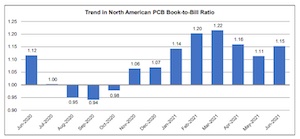
IPC announced the June 2021 findings from its North American Printed Circuit Board (PCB) Statistical Program. The book-to-bill ratio stands at 1.15.
Total North American PCB shipments in June 2021 were up 6.3 percent compared to the same month last year. Compared to the preceding month, June shipments grew 17.3 percent.
PCB bookings in June rose 19.4 percent year-over-year. Bookings in June increased 28.9 percent from the previous month.
“We saw strong PCB orders in June, outstripping any month since early 2006. The electronics supply remains constrained and companies continue to look for any available capacity,” said Shawn DuBravac, IPC’s chief economist. “Shipments also picked up strongly during the month, suggesting some disruptions are starting to improve and companies are increasingly able to fulfill incoming orders.”
Detailed Data Available
Companies that participate in IPC’s North American PCB Statistical Program have access to detailed findings on rigid PCB and flexible circuit sales and orders, including separate rigid and flex book-to-bill ratios, growth trends by product types and company size tiers, demand for prototypes, sales growth to military and medical markets, and other timely data.
Interpreting the Data
The book-to-bill ratios are calculated by dividing the value of orders booked over the past three months by the value of sales billed during the same period from companies in IPC’s survey sample. A ratio of more than 1.00 suggests that current demand is ahead of supply, which is a positive indicator for sales growth over the next three to twelve months. A ratio of less than 1.00 indicates the reverse.
Year-on-year and year-to-date growth rates provide the most meaningful view of industry growth. Month-to-month comparisons should be made with caution as they reflect seasonal effects and short-term volatility. Because bookings tend to be more volatile than shipments, changes in the book-to-bill ratios from month to month might not be significant unless a trend of more than three consecutive months is apparent. It is also important to consider changes in both bookings and shipments to understand what is driving changes in the book-to-bill ratio.
IPC’s monthly PCB industry statistics are based on data provided by a representative sample of both rigid PCB and flexible circuit manufacturers selling in the USA and Canada. IPC publishes the PCB book-to-bill ratio by the end of each month.
Testimonial
"We’re proud to call I-Connect007 a trusted partner. Their innovative approach and industry insight made our podcast collaboration a success by connecting us with the right audience and delivering real results."
Julia McCaffrey - NCAB GroupSuggested Items
STARTEAM GLOBAL Achieves A Score in CDP’s Supplier Engagement Assessment
05/14/2026 | STARTEAM GLOBALSTARTEAM GLOBAL has achieved an A score in CDP’s Supplier Engagement Assessment (SEA).
Rethinking Stackup, Materials, and Tolerances in Modern Designs
05/14/2026 | Kristin Moyer, Global Electronics AssociationThe simple rectangular rigid PCB is becoming increasingly infrequent. This reality necessitates designing with concepts well outside traditional rigid PCB methodologies. For example, the designer of wearable electronics may need to implement conductive fibers integrated into the textile material. Heads-up displays, like those in VR/AR headsets and glasses, require transparent circuitry etched into the display glass. The process of designing without a rule book usually starts with something other than the traditional board design process.
Separating Fact from Fear on the FCC ‘China Lab Ban’
05/14/2026 | Jan Pedersen, NCAB GroupRecent news headlines have suggested that the U.S. Federal Communications Commission (FCC) has “banned all testing laboratories in China and Hong Kong.” Understandably, this has created concerns around PCB testing, material approvals, UL listings, and the continued use of established test laboratories in Asia. The good news is that for most PCB, PCB material, and PCBA testing, nothing has changed. Let’s separate fact from fear.
Zhen Ding Reports Record 1Q26 Revenue; Up 1.6% YoY
05/14/2026 | Zhen Ding TechnologyZhen Ding Technology Holding Limited, a global leading PCB manufacturer, announced its consolidated financial results for the first quarter of 2026. First quarter revenue reached NT$40,728 million, up 1.6% YoY and setting a record high for the same period. Net income was NT$2,047 million, and net income attributable to the parent company was NT$1,426 million, with EPS of NT$1.33.
New Courses: Advance Your Electronics Expertise in June and July
05/14/2026 | Global Electronics AssociationStay current with design, manufacturing, and quality standards by enrolling in one of these online instructor-led courses starting in June and July from ElectronicsU at the Global Electronics Association, designed to help professionals at every level sharpen their skills and advance their careers. These live, expert-led sessions combine flexibility with real-time interaction, allowing participants to learn directly from seasoned industry professionals while collaborating with peers worldwide. Access to all applicable IPC standards is included in the courses.