













 American Made Advocacy: Don’t Build Our AI Economy on Foreign-sourced Components
  Defense Speak Interpreted: Will Defense Become a Totally New Supplier for Drone Electronics?
 The Right Approach: The End of an Era—DoD Proposes MIL-PRF-31032 Cancellation





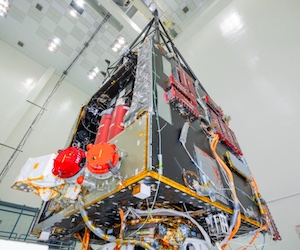
When it comes time for NASA’s Psyche spacecraft to power itself through deep space, it’ll be more brain than brawn that does the work. Once the stuff of science fiction, the efficient and quiet power of electric propulsion will provide the force that propels the Psyche spacecraft all the way to the main asteroid belt between Mars and Jupiter. The orbiter’s target: a metal-rich asteroid also called Psyche.
The spacecraft will launch in August 2022 and travel about 1.5 billion miles (2.4 billion kilometers) over three and a half years to get to the asteroid, which scientists believe may be part of the core of a planetesimal, the building block of an early rocky planet. Once in orbit, the mission team will use the payload of science instruments to investigate what this unique target can reveal about the formation of rocky planets like Earth.
The spacecraft will rely on the large chemical rocket engines of the Falcon Heavy launch vehicle to blast off the launchpad and to escape Earth’s gravity. But the rest of the journey, once Psyche separates from the launch vehicle, will rely on solar electric propulsion. This form of propulsion starts with large solar arrays that convert sunlight into electricity, providing the power source for the spacecraft’s thrusters. They’re known as Hall thrusters, and the Psyche spacecraft will be the first to use them beyond the orbit of our Moon.
At left, xenon plasma emits a blue glow from an electric Hall thruster identical to those that will propel NASA's Psyche spacecraft to the main asteroid belt. On the right is a similar non-operating thruster.
For propellant, Psyche will carry tanks full of xenon, the same neutral gas used in car headlights and plasma TVs. The spacecraft’s four thrusters will use electromagnetic fields to accelerate and expel charged atoms, or ions, of that xenon. As those ions are expelled, they create thrust that gently propels Psyche through space, emitting blue beams of ionized xenon.
In fact, the thrust is so gentle, it exerts about the same amount of pressure you’d feel holding three quarters in your hand. But it’s enough to accelerate Psyche through deep space. With no atmospheric drag to hold it back, the spacecraft eventually will accelerate to speeds of up to 200,000 miles per hour (320,000 kilometers per hour).
Because they’re so efficient, Psyche’s Hall thrusters could operate nearly nonstop for years without running out of fuel. Psyche will carry 2,030 pounds (922 kilograms) of xenon in its tanks; engineers estimate that the mission would burn through about five times that amount of propellant if it had to use traditional chemical thrusters.
“Even in the beginning, when we were first designing the mission in 2012, we were talking about solar electric propulsion as part of the plan. Without it, we wouldn’t have the Psyche mission,” said Arizona State University’s Lindy Elkins-Tanton, who as principal investigator leads the mission. “And it’s become part of the character of the mission. It takes a specialized team to calculate trajectories and orbits using solar electric propulsion.”


