












 Knocking Down the Bone Pile: Hot Air vs. Infrared PCB Rework
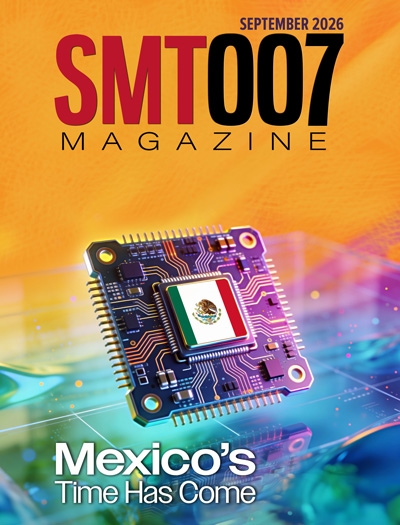
 Nolan’s Notes: Why Mexico’s Time Has Come
 Standard of Excellence: ‘Quality’ Is Your Company's Greatest Competitive Advantage





In I-Connect007’s inaugural On the Line with… podcast, we spoke with six experts in sustainability and electronics manufacturing from Siemens Digital Industries Software: Susan Kayesar, Mark Laing, Patrick McGoff, and Christian Wendt. Other podcasts in the series feature Zac Elliott and Jonathan Fromm. After recording the episodes, we gathered to discuss the series: the content, challenges, potential solutions, and the impact on our industry. Excerpts from that roundtable conversation are transcribed here.
Nolan Johnson: We just all finished recording a series of podcasts on the topic of sustainability with you as our subject matter experts. Sustainability really is a key topic for all industries right now; electronics manufacturing is no exception. Why is sustainability so important to Siemens, to our shared readers, our shared customers?
Patrick McGoff: Siemens, being a global corporation, takes the lead on initiatives that serve beyond just their commercial interests. They’ve always been a thought leader and are inspiring other companies to follow with things that not just change industry, but to change the world. They’ve made it a priority to make sustainability one of their focuses in recent years and going forward. We all try to follow that guidance given there and look for opportunities where we can address that within our areas of domain.
Susan Kayesar: I’m going to go back to something that you touched on in our interview when you were talking about survival of the fit-test. We were saying that awareness of sustain-ability issues is really on the rise globally. Not just in terms of legislation, but also in terms of, ethically speaking, the right thing to do and how we keep our world safe and preserve it for future generations. If we as a global company can be part of that preservation, we have a moral responsibility to do that.
Christian Wendt: We touched on the topic of circular economy, and how we can ensure that we are making the best out of the resources we have on our planet. And this is something that we as a global company are looking at.
Mark Laing: It’s about the future, not just today, not achieving our goals for today, but thinking about the future and where we want to take things. How do we hand over this world to the next generation and the people after that? It’s in some ways a necessary evil. But if we can make that as efficient as possible, the knock-on effects are significant. For all the technologies that we also need to rely on moving forward, such as electric vehicles, wind, solar panels—all of that is going to rely on efficient electronics.
Johnson: I certainly found these conversations to be very enlightening for me personally, and to interact with all of you as we went through those conversations. We talked about what sustainability means. And in all the different facets that were covered, that was a great process to go through for me personally. I certainly hope the listeners feel the same way.
Kayesar: I say start now, right where you are. Any small thing that you can do to contribute to the effort will be returned ten-fold, a thousand-fold, in years to come.
McGoff: If you’re achieving something that makes things more sustainable, you’re making it more possible for your clients in the future to achieve success with your solutions. If we do begin now, if we do take the small steps, if we look at each element that we can address and affect, then we do have the ability to have a positive outcome for the future of our companies as well as our children.
Johnson: Thank you very much for joining me to talk about this. It has been a pleasure working with all of you, putting this series together.
Kayesar: Thanks for having us, Nolan.
Click here to listen to episodes 1 through 5 of On the Line with... Season 1: Sustainability with Siemens of brought to you by I-Connect007.


