














 Knocking Down the Bone Pile: Hot Air vs. Infrared PCB Rework
 Nolan’s Notes: Why Mexico’s Time Has Come
 Standard of Excellence: ‘Quality’ Is Your Company's Greatest Competitive Advantage





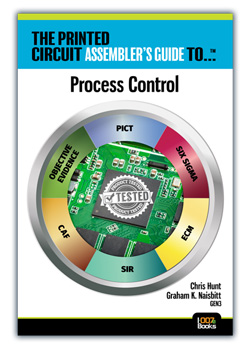
Excerpt from: The Printed Circuit Assembler’s Guide to...Process Control
Chapter 1: How Did We Get Here?
Measuring SIR has been in use since at least the 1970s. We are aware that Siemens in Germany and GEC Marconi in the UK both developed SIR test systems that have remarkably similar measurement techniques. In 1987, research commenced to evaluate alternative chemistries to CFCs, such as Freon®, to be used in the cleaning of electronic assemblies. The pressure for this came from the Montreal Protocol, an international treaty designed to protect the ozone layer by phasing out the production of numerous substances responsible for ozone depletion. It was agreed on 16 September 1987 and entered into force on 1 January 1989.
This research was initially conducted by IVF (The Swedish Institute for Production Engineering based in Gothenburg) on behalf of business groups throughout the Baltic territories, and by NPL (The British National Physical Laboratory near London) on behalf of several major electronics businesses in the UK and Ireland. (GEN3 have a library of the majority of papers produced by both groups for anyone who is interested.)
The major obstacle encountered was: how do you assess how clean is clean—especially when the process control tool in use at that time was the ROSE test. The ROSE test, of course, needs to be considered as a cleaning process, so there is overlap and conflict with the cleaning technologies. This was especially problematic when “no-clean” fluxes were introduced, as cleaning was not intended; but, then, how do we measure? This is where SIR testing came into broader use. GEC were the only company who commercialised their equipment—the prototype AutoSIR we manufacture today.
It was in 1990 that the first known effort to implement objective evidence was done by GEC Meters in the UK, by the team under the leadership of B.J. Mason. The resulting paper, “No-clean Flux Appraisal—The Total Process Approach” was published by Circuit World Vol. 20, No. 2, 1994. The industry resolutely continued using the ROSE test for optimum convenience, so much so that it became regarded as the “Cleanliness Test” but…
Continue reading this book by visiting our library here.


