












 Defense Speak Interpreted: The Impact of Venture Capital-backed Defense Contractor Firms
 American Made Advocacy: Don’t Build Our AI Economy on Foreign-sourced Components
  The Right Approach: The End of an Era—DoD Proposes MIL-PRF-31032 Cancellation





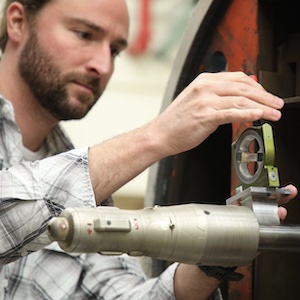
The same facility that provided valuable testing for NASA missions to low-Earth orbit and the Moon is now helping the agency prepare to launch the first rocket from Mars.
The MAV (Mars Ascent Vehicle) team recently completed wind tunnel testing at NASA’s Marshall Space Flight Center in a facility that has been a critical part of NASA missions going all the way back to the Apollo program.
The same facility that provided valuable testing for NASA missions to low-Earth orbit and the Moon is now helping the agency prepare to launch the first rocket from Mars. The MAV is an important part of the joint plan between NASA and ESA (European Space Agency) to bring scientifically selected Martian samples to Earth in the early 2030s.
The testing took place July 10-15 and allowed the team to gather aeroacoustic data to help them understand the dynamics of MAV’s design using 3D-printed scale models.
“With these successful tests, we are improving our understanding of MAV aerodynamics, integrated performance, controllability, and vehicle loading,” said MAV Project Manager Steve Gaddis. “We will use the results to inform our design and make any needed improvements for the robust MAV needed to deliver Martian rock samples to orbit.”
The test section of Marshall’s wind tunnel is only 24 inches long and 14 inches in height and width. However, it can achieve supersonic speeds of up to Mach 5 (about 3,800 mph) and has a long history of testing iconic rockets, including Redstone, Jupiter-C, and Saturn, as well as space shuttle and SLS (Space Launch System) designs.
MAV aeroacoustics lead Annie Catherine Barnes, who served as co-lead for the July testing campaign, said the team tested scale models at multiple angles inside the wind tunnel to see how air flow might affect MAV’s structure. Barnes compared it to turbulence on an airplane.
“We’re looking for areas of turbulent flow for launch vehicles,” she said. “We’re looking for shock oscillations and large areas of pressure fluctuation that can cause a structural response.”
The team will use data from the July testing campaign and other analyses to form a better estimate of the environments MAV would face as it becomes the first vehicle to launch from the surface of another planet.
MAV supports the planned Mars Sample Return campaign, which would bring scientifically selected samples to Earth for study using the most sophisticated instrumentation around the world. This strategic partnership with ESA is developing the technology and the preliminary designs for missions that would accomplish the first return samples from another planet. The samples currently being collected by NASA’s Perseverance rover during its exploration of an ancient river delta have the potential to reveal the early evolution of Mars, including the potential for ancient microbial life.
Managed at Marshall, the MAV would launch aboard the Sample Retrieval Lander from Earth for a two-year journey to Mars. It would remain on the surface of Mars for nearly a year of receiving the samples collected by Perseverance.
After the Sample Transfer Arm on the lander loads the samples into a container in the rocket, MAV would launch from Mars into orbit around the planet, releasing the sample container for the ESA-developed Earth Return Orbiter to capture.
The samples are targeted to arrive on Earth in the early 2030s. The Mars Sample Return Program is managed by NASA’s Jet Propulsion Laboratory in Southern California.


