












 It’s Only Common Sense: If You’re Not Differentiated, You’re Dead
 Alpha Insights, Performance by Design: The Future of PCB Manufacturing in the Midwest
 Happy’s Tech Talk #43: Engineering Statistics Training With Free Software





Reports Indicate TSMC to Tighten Scrutiny on Chinese AI Chip Clients; Potential Revenue Impact Between 5% to 8%
November 11, 2024 | TrendForceEstimated reading time: 2 minutes
Reports suggest that TSMC has notified its Chinese clients of a temporary suspension on shipments of advanced AI chips produced using 7nm and below process nodes. Additionally, Chinese clients seeking future advanced process projects will be subject to strict review to ensure the chips are not used for AI or other restricted purposes. TrendForce posits that if the policy takes effect, it could impact TSMC’s revenue performance and utilization rates of its 7nm and below advanced process capacity, while also affecting the future development of China’s AI industry.
The scrutiny follows the revelation that TSMC’s 7nm technology was used in Huawei’s 910B chip. This raised concerns over potential violations of US export regulations, along with allegations that certain companies may have acted as intermediaries to place advanced AI chip orders on behalf of Chinese firms. In response, TSMC is re-evaluating its KYC process and plants to improve its client approval standards, expand product review criteria, and potentially impose additional restrictions on chip size and HBM usage.
TrendForce notes that TSMC is highly likely to implement these measures in the near term, although the full impact will depend on whether the U.S. Department of Commerce issues additional export control regulations or adds specific customers to the Entity List.
For the first three quarters of 2024, TSMC’s revenue distribution shows that advanced nodes accounted for 67% of its total revenue—a key revenue source. However, TrendForce highlights that the major clients for TSMC’s 7/6n, 5/4nm, and 3nm processes are primarily from the U.S., Europe, and Taiwan. Consequently, even if regulatory actions impact business some Chinese clients may be lost, TrendForce expects other customers to offset this loss, limiting the potential effect on advanced process utilization rates.
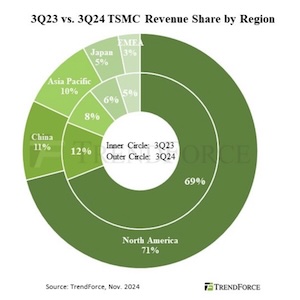
TSMC’s revenue from China has remained steady at 11% to 13% for the full year of 2023 and the first three quarters of 2024. If regulatory scrutiny of TSMC’s advanced processes intensifies, or if certain Chinese clients are added to the Entity List—particularly affecting Chinese AI-related IC design companies, IP providers, third-party design services, or other businesses that depend on TSMC’s advanced processes for project initiation, tape-outs, and mass production—TSMC could face a revenue impact of approximately 5% to 8%. However, strong global demand for AI chips and TSMC’s planned price increases for advanced process clients are expected to help mitigate some of this impact.
Share on:


Testimonial
"Our marketing partnership with I-Connect007 is already delivering. Just a day after our press release went live, we received a direct inquiry about our updated products!"
Rachael Temple - AlltematedSuggested Items
NEDME Returns October 22 — The Northwest’s Premier Design & Manufacturing Expo
10/13/2025 | NEDMEThe Northwest Electronics Design & Manufacturing Expo (NEDME) returns on Wednesday, October 22, 2025, at Wingspan Event & Conference Center, Hillsboro. The event brings together engineers, product designers, manufacturers, educators, and community partners for a full day of industry connection, learning, and networking.
Interposers, Substrates, and Advanced Manufacturing
10/13/2025 | Marcy LaRont, I-Connect007I attend a lot of industry trade shows and conferences. Lately, during conversations with technologists, I’ve noticed that there is some confusion about what exactly constitutes an interposer. One question I hear every so often is, “Are all interposers substrates?” The short answer to that question is no. But some interposers are, in fact, full substrates.
I-Connect007 Editor’s Choice: Five Must-Reads for the Week
10/10/2025 | Nolan Johnson, I-Connect007I-Connect007 has a new monthly digest newsletter, the Advanced Electronic Packaging Digest, and as I was scanning our advanced packaging newsfeeds this week, I came across a primer from tokenring.ai (republished through station WRAL, Raleigh, North Carolina), which I found quite useful. Whether you’re a designer, fabricator, or assembler, the package schemes being developed will change how you work, so be sure to keep your eye on the technological horizon and subscribe to the monthly Advanced Electronic Packaging Digest.
The Latest Issue: Advanced Electronics Packaging Digest to Explore Critical Minerals, Substrates, and Reliability Standards Driving Next-Gen Electronics
10/09/2025 | I-Connect007I-Connect007 is pleased to announce the upcoming issue of Advanced Electronics Packaging Digest (AEPD) on October 13, 2025, featuring expert insights on the technologies shaping the future of advanced packaging. As the electronics industry evolves, this issue takes a closer look at the materials, designs, and standards redefining performance and reliability across global markets.
Advanced Rework Technology Inspires Students at National Manufacturing Day 2025
10/08/2025 | A.R.T. Ltd.Advanced Rework Technology Ltd. (A.R.T.), a leading independent IPC-accredited training provider, joined forces with Jaltek, a UK-based electronics manufacturer with over 35 years’ experience in designing and producing high-quality electronic products, to deliver hands-on workshops for students during National Manufacturing Day 2025.