













-
- News
- Books
Featured Books
- I-Connect007 Magazine
Latest Issues
Current Issue
Signal Integrity & Metallization
Signal integrity and additive manufacturing, particularly metallization, are hot topics in PCB design and fabrication. PCB layouts are carefully engineered to achieve specific electrical and power performance targets.
Beyond the Rulebook
What happens when the rule book is no longer useful, or worse, was never written in the first place? In today’s fast-moving electronics landscape, we’re increasingly asked to design and build what has no precedent, no proven path, and no tidy checklist to follow. This is where “Design for Invention” begins.
March Madness
From the growing role of AI in design tools to the challenge of managing cumulative tolerances, these articles in this issue examine the technical details, design choices, and manufacturing considerations that determine whether a board works as intended.
- Articles
- Columns
- Links
- Media kit
||| MENU - I-Connect007 Magazine
New IPC Standard Sets First Global Benchmark for E-Textile Wearable Reliability
April 29, 2025 | IPCEstimated reading time: 1 minute
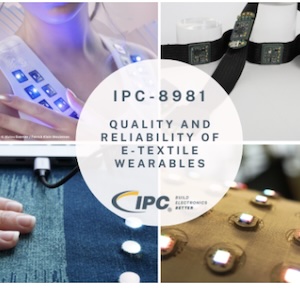
IPC announces the release of IPC-8981, Quality and Reliability of E-Textile Wearables. This first-of-its-kind standard sets baselines for testing and classifying e-textile wearables, addressing key challenges in product reliability, performance, and quality assurance. IPC-8981 introduces a common framework for evaluating wearables that integrate electronics directly into textile materials—applications that span healthcare, defense, fitness, and consumer technology.
The standard was developed by the IPC E-Textiles Wearables Standard Task Group, led by Vladan Koncar of ENSAIT GEMTEX Lab – University of Lille and Sigrid Rotzler of Fraunhofer-Institut fur Zuverlassigkeit und Mikrointegration. The task group included international experts from both the textile and electronics industries, bringing multidisciplinary insight to the testing needs of e-textile wearables.
“As the first standard of this kind, IPC-8981 provides a solid basis for e-textile developers to make their products more reliable, set quality targets, and choose relevant testing methods,” Rotzler explained.
Added Koncar, “Our IPC-8981 standard and the associated test methods are essential: They help companies from both the textile and electronics sectors collaborate more effectively to develop high-quality products that are ready for market adoption.”
IPC-8981 is supported by 14 newly published IPC-TM-650 Test Methods covering environmental and mechanical durability factors such as abrasion, perspiration, UV exposure, and washing. It also offers guidance on part classification, testing thresholds, and how to reduce unnecessary testing steps to streamline development.
The release of IPC-8981 marks a pivotal step forward for the e-textiles wearables industry—providing the tools needed to transform wearable electronics from promising prototypes into reliable, market-ready solutions.
To purchase IPC-8981, visit the IPC Store. To learn more to join the IPC E-Textiles Wearables Standard Task Group and guide future enhancements to the standard, visit IPC's committee page.
Testimonial
"The I-Connect007 team is outstanding—kind, responsive, and a true marketing partner. Their design team created fresh, eye-catching ads, and their editorial support polished our content to let our brand shine. Thank you all! "
Sweeney Ng - CEE PCBSuggested Items
Punching Out: How Are the Big Boys in Electronics Doing?
05/12/2026 | Tom Kastner -- Column: Punching Out!Let’s see what the public companies are up to in the PCB and EMS industries. In North America, there are only a couple of publicly traded PCB companies: TTM Technologies and Firan Technology Group. On the EMS side, there are a few more: Flex, Jabil, Celestica, Sanmina,, Benchmark, Fabrinet, Kimball Electronics, Plexus Corp, Nortech Systems, and Key Tronic Corp. From an M&A standpoint, these public companies have been fairly quiet in the past five years. FTG completed two deals in 2022 (IMI and Holaday), Flex had three deals, Jabil had five deals, and Sanmina had one deal.
I-Connect007 Editor’s Choice: Five Must-Reads for the Week
05/08/2026 | Marcy LaRont, I-Connect007This week, I’ve selected some outstanding interviews that you’ll want to take note of. First, is a roundtable discussion featuring three dynamic industry cybersecurity experts. Please watch this important discussion that affects us all. Following that, I spotlight the IPC-2581 Consortium, which explains why IPC-2581 is the standard to replace Gerber data for manufacturing. Next, I am including my interview with PCBAA and AAM, who collaborated to release a short documentary on U.S. PCB manufacturing.
A Necessary Shift From Gerber to IPC-2581
05/07/2026 | Tracy Riggan, Global Electronics AssociationIPC-2581 is an open, vendor-neutral data exchange standard developed by the Global Electronics Association to streamline the exchange of PCB design information across fabrication, assembly, and test. It replaces multiple legacy formats—including industry standards, Gerber, and ODB++—with a single, comprehensive, XML-based dataset that captures all manufacturing details.
ViaSat-3 F3 Satellite Successfully Launches from Kennedy Space Center
05/04/2026 | BoeingBoeing mission controllers confirmed that the ViaSat-3 F3 (VS-3 F3) satellite is healthy in orbit following its successful launch aboard a SpaceX Falcon Heavy rocket at 10:13 a.m. ET from Kennedy Space Center (KSC) in Florida.
Microchip Expands Post-Quantum Root of Trust Controllers
04/29/2026 | MicrochipAs the industry embarks on the transition to post‑quantum cryptography (PQC), Microchip Technology is expanding its portfolio of Trust Shield, PQC‑ready devices with the TS1800 Platform Root of Trust controller and the TS50x secure boot controller.