













 Flexible Thinking: Designing Flex Circuits for Dynamic Reliability
 Global PCB Connections: Rigid-flex and Flexible PCBs—The Backbone of Modern Electronics
 Happy’s Tech Talk #29: Bend-to-Install Semi-flex FR-4





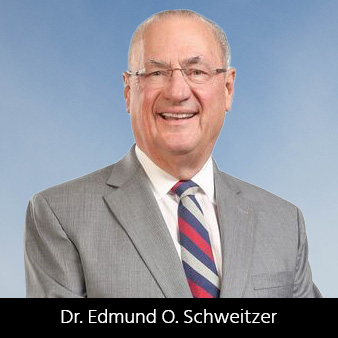
Dr. Edmund O. Schweitzer III, founder of Schweitzer Engineering Laboratories (SEL), has a corner office in the company’s world headquarters in Pullman, Washington. Forty-two years after his SEL-21—the first microprocessor-based digital protective relay—ushered in a new era of power-system protection, he has forever changed the way the world safeguards its electric grids.
In this fascinating three-hour conversation, Dr. Schweitzer reveals that he remains excited to get to work each day, unpacking the “better, cheaper, faster, simpler” mantra that’s still driving SEL’s innovation, and the culture glue that keeps more than 7,000 employee-owners rowing in unison. He’s a visionary who believes strongly in creativity and refuses to rest on yesterday’s breakthroughs.
Barry Matties: Ed, let’s start by talking about your early career. You remember the days when many OEMs manufactured their own printed circuit boards.
Ed Schweitzer: In fact, I worked in one. I grew up in the Chicago area, and while I was in college, around 1966, I worked for Nuclear Chicago, a company that made radiation counters, Geiger counters, film badges—pretty much anything nuclear. They also made all their own circuit boards.
These were the newer days of integrated circuits. At the time, an op-amp (operational amplifier) and a little TO-5 (transistor package) would cost five bucks, which would be $50 today. But it was better, cheaper, faster, and simpler than trying to do it with a 12AT7 vacuum tube.
Matties: If you counted every time you've said “better, cheaper, faster, simpler” in your life, there’s not a calculator big enough.
Schweitzer: Probably not, but that's what we ought to be doing.
Matties: What resistance did you get when you challenged conventional thinking, and how did that surprise you?
To read the entire interview, which appeared in the August 2025 issue of PCB007 Magazine, click here.


