















 Marcy’s Musings: A Frighteningly Good October Issue
 It’s Only Common Sense: Win the Sale Before the RFQ Arrives
 The Marketing Minute: Marketing Is a Team Sport





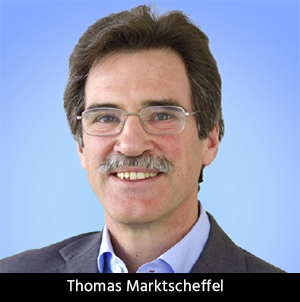
When Tom Marktscheffel, director of product management software solutions at ASMPT, looks back on his nearly three decades in electronics manufacturing, one word stands out: data.
“Data is the new gold,” he says. Without it, automation, artificial intelligence, and the factory of the future are impossible. With it, the industry can move from manual, error-prone processes to smart, connected systems that make real-time decisions.
That vision lies at the heart of the Connected Factory Exchange (CFX) standard, which Tom has helped lead since its inception. Today, he chairs the 2-17: Connected Factory Initiative Subcommittee and 2-17A: IPC-CFX Standard Task Group and is an active member of the CFX A-team, the Plug & Players. These are working groups of volunteers shaping how factories communicate and operate worldwide. Besides his CFX activities, he chairs the 2-10: Electronic Product Data Description Committee and co-chairs 2-17B: IPC-HERMES-9852 Standard Task Group.
Why CFX Matters
Nearly a decade ago, the industry faced a communication problem. Each equipment vendor had its own “standard” for data exchange—if it had one at all. Integrators and software providers spent countless hours writing translation layers to get machines to talk to each other. “It was like trying to build a global factory where every machine spoke a different language,” Tom says.
CFX changed that. By defining not only what data is communicated, but also how it is structured and transmitted, the standard ensures that every machine can “speak the same language.”
Continue reading this article in the Fall 2025 issue of Community Magazine, a partnership with the Global Electronics Association and I-Connect007.


