














 The Fearless Connector: Why I Chose the Hard Road
 The Clean Truth: The Clean Truth About No-Clean Flux
 Global Sourcing Spotlight: Beyond China Plus One—Building a Truly Global Supply Network







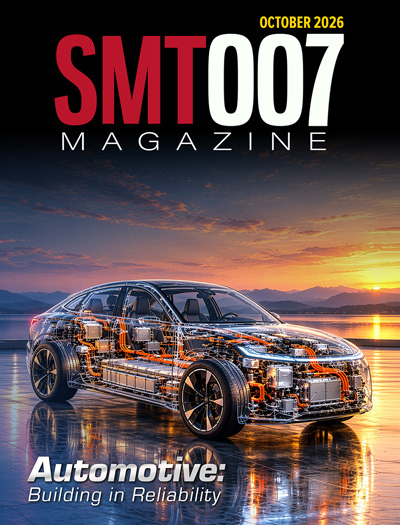
Phil Kinner, head of conformal coatings at Electrolube, talks to I-Connect007’s Stephen Las Marias about the impact of increasing electronics in cars on conformal coating requirements. He also highlights the best practices that help automotive electronics makers select the correct conformal coating solution for their applications.
Stephen Las Marias: What major changes have you witnessed in the automotive electronics sector over the past several years?
Phil Kinner: The automotive electronics industry has evolved rapidly during the last decade. The most striking aspect is the way that the use of electronic controls, sensors, safety features and in-cabin entertainment, communications and navigation, have been adopted in mid and low-end vehicles. Automobiles are now much safer, more fuel-efficient and more comfortable as a direct result of the increased adoption of electronics.
On top of this, we have seen the emergence of electric vehicles offering a more environmentally acceptable alternative to fossil-fuel-based vehicles. These electric vehicles now have a range that is useful to most commuters (150–200km) and we are seeing a rapid installation of charging stations and other infrastructure requirements to make these vehicles more mainstream.
Finally, we've seen the emergence of smart cars that can communicate with each other, making pre-emptive interventions to help maintain safety and avoid collisions, with 'driverless' vehicles making daily journeys on highways and other roads without major incident. Who would have thought that would be close to a practical possibility a decade ago?
Las Marias: What can you say about the increasing reliability requirements in automotive electronics? Where does Electrolube come in to help your customers address this issue?
Kinner: I would say that the challenges on electronics reliability in the automotive industry are perhaps higher even than aerospace applications, due to the fact that aerospace systems usually have at least two back-up systems that automotive systems do not. The elimination of cleaning from many automotive electronics assembly processes has placed an even greater emphasis on the performance requirements of the protective coatings.
Given the volume of automotive parts produced, the use of solvent-containing products is discouraged to help meet solvent-emissions targets. The list of prohibited substances for use in automotive applications continues to grow. The manufacturing processes need to be lean and provide one piece flow at the maximum possible, defect-free, manufacturing velocity.
As an ISO14000 company itself, Electrolube is dedicated to producing products that can help automotive manufacturers achieve all these requirements. Whether it is the demonstrably higher performance solvent-free conformal coatings, encapsulation resins for more demanding applications, high-performance lubricants and greases for enhancing switches, bearings and other moving parts or advanced thermal management for keeping assemblies cool to extend their lifetimes, Electrolube has a great portfolio of products to help enhance the reliability and productivity of automotive electronics.
Editor's Note: This article originally appeared in the September 2015 issue of SMT Magazine.


