





Surprising Discovery of a New Particle that Could be Used in Electronics
November 30, 2015 | ETH ZurichEstimated reading time: 3 minutes
Studying peculiar properties of a long known metallic material researchers have chanced upon a new particle. It is related to the so-called Weyl fermions that the mathematician Hermann Weyl predicted almost ninety years ago. Weyl had overlooked the particle, which could have interesting applications in electronics.
When ETH professor Hermann Weyl arrived for his one-year tenure as guest professor at Princeton in the autumn of 1928, the quantum physicist Paul Dirac had just published his celebrated formula for the electron. That formula described the properties of so-called fermions, or quantum particles with half-integer spin, and its predictions - among them the existence of anti-matter – ushered in the era of modern particle physics. Weyl realized that, in principle, Dirac’s equation also allowed solutions for particles without mass. In 1929 he published a paper in which he described those massless particles with half-integer spin. They would later be called “Weyl fermions”.
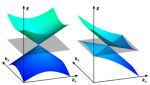
Physicists at the ETH, together with researchers at Princeton University and at the Chinese Academy of Sciences, have now found a thus far unknown particle that their illustrious forebear had overlooked in his calculations and that had remained undetected for almost ninety years thereafter. They named it “type-2 Weyl fermion”.
Search for New Material Properties
The researchers hit upon the new kind of particle when trying to understand strange physical properties of the metal tungsten ditelluride (WTe2). “We were hoping to find especially so-called ‘topological’ properties that make certain quantum states more resistant to perturbations in this metal material”, explains Alexey Soluyanov, a researcher in the Computational Physics group at ETH Zurich.
In order to simulate the physical properties of the metal crystals the researchers ran calculations for 200,000 hours on supercomputers at the Swiss National Supercomputing Centre CSCS and at the Chinese Academy of Sciences. It required weeks of detailed derivations and calculations before the researchers came to the conclusion that they must have discovered something totally new: inside the tungsten ditelluride crystal there had to exist a thus far unknown type of fermion, the type-2 Weyl fermion.
Page 1 of 2
Subscribe
Stay ahead of the technologies shaping the future of electronics with our latest newsletter, Advanced Electronics Packaging Digest. Get expert insights on advanced packaging, materials, and system-level innovation, delivered straight to your inbox.
Subscribe now to stay informed, competitive, and connected.
Suggested Items
Target Condition: When Design Outpaces Manufacturing
04/23/2026 | Kelly Dack -- Column: Target ConditionMost PCB designers already understand why design for manufacturing (DFM) matters. If a product can’t be built reliably, repeatedly, and at a price anyone will actually pay, it’s dead on arrival. You may have the most elegant schematic and layout ever drawn in a CAD tool, but if the PCB suppliers can’t make it, or the EMS sources refuse to quote it, you may well be considered more of a Nutty Professor or well-meaning inventor than a PCB designer.
IBM's David Lokken-Toyli: Quantum’s Call to ‘Leap’
04/10/2026 | Marcy LaRont, I-Connect007What happens when a cutting-edge quantum computer is placed in the middle of a public cafeteria? For David Lokken-Toyli, principal research scientist at IBM Quantum, that image, now a reality at Cleveland Clinic, captures a turning point: Quantum computing is moving out of the lab and into the real world, and getting there will depend not just on physicists, but on an electronics supply chain ready to support entirely new system requirements.
Meet Emerging Engineer Logan Bistodeau, IBM
04/09/2026 | Michelle Te, I-Connect007When he was growing up, Logan Bistodeau was always interested in how heavy machinery worked, so it was natural that he earned a mechanical engineering degree at Iowa State University. He originally grew up near the Twin Cities in Minnesota, now works for IBM, and is in his first year of the Emerging Engineer Program through the Global Electronics Association. I got to know Logan a little better at APEX EXPO 2026.
EMS Leaders Express Optimism Through Growth and Expansion
03/18/2026 | Mark Wolfe, Global Electronics AssociationIt was a strong opening day for APEX EXPO 2026, with a keynote by Zach Kass on the AI revolution, followed by a ribbon-cutting to officially open the event, which featured Irish dancers on this St. Patrick’s Day, and opening remarks by Global Electronics Association CEO John Mitchell. But I’d like to tell you about the EMS Leadership Summit on Monday, where approximately 60 EMS industry leaders from 40 companies participated. There were several speakers, a panel discussion, and discussion groups.
Punching Out: How Many PCB Companies Are There in North America Now?
03/19/2026 | Tom Kastner -- Column: Punching Out!When I am asked how many PCB shops are still in the U.S., my answer is usually, “About 130. How many do you want to buy?” However, I do not really know the number. My job is either to sell PCB shops or help people buy them, not to count them. I probably should keep better track of them, but many are small (70% have revenue below $10 million), or they say they are making boards even if they rent out their facility as an auto repair shop.