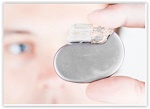








Glucose as a New Energy Source for Pacemakers
May 2, 2016 | R&I WorldEstimated reading time: 1 minute
Researchers at the Instituto Tecnológico de la Energía (Technological Institute of Energy, ITE) are working on the creation of a bio-battery that uses blood glucose to produce energy. Such a battery would cut down on the number of surgical interventions a pacemaker user must undergo.
Current batteries are hardwearing and work well for implants that do not require much energy. However, when they run out, the patient must undergo surgery to replace them. Even devices that do not use much electricity, like pacemakers, have a limited useful life given this dependence on batteries.
The challenge of research in this area lies in developing electrodes made from materials that are compatibile with the human body, and able to oxidise blood glucose and convert it into fuel.
Mireia Buaki, project leader at the ITE, tells us more: “Glucose and oxygen are readily available in the human body, meaning our bio-battery could keep working indefinitely. Once the electrodes are fully developed, the next step will be to build a prototype bio-battery and test it to see whether it is able to obtain and store enough energy to power small implantable electronic devices, like pacemakers and cochlear implants.”
The ITE has been working on the development of polymeric and carbonaceous materials for energy generation and storage systems, like this new battery, for many years. This technology is very versatile and could have many applications across a diverse range of fields, from the analysis and detection of substances in foodstuffs, to wastewater treatment.
This research is being developed under the State Programme for the Promotion of Talent and Employability of the Spanish Ministry of Economy and Competitiveness.
Subscribe
Stay ahead of the technologies shaping the future of electronics with our latest newsletter, Advanced Electronics Packaging Digest. Get expert insights on advanced packaging, materials, and system-level innovation, delivered straight to your inbox.
Subscribe now to stay informed, competitive, and connected.
Suggested Items
Keysight, CATARC Expand Collaboration on Charging Test Technologies
05/06/2026 | BUSINESS WIREKeysight Technologies, Inc. announced an expanded strategic collaboration with China Automotive Technology and Research Center (CATARC) New Energy Vehicle Inspection Center, marked by the establishment of a Joint Innovation Laboratory for Charging Test Technology.
Dan’s Biz Bookshelf: ‘Abundance: How We Build a Better Future’
05/07/2026 | Dan Beaulieu -- Column: Dan's Biz BookshelfEvery once in a while, a book comes along that doesn’t just make you think, it makes you sit up straighter and ask: Why aren’t we doing this better? "Abundance" is exactly that kind of book. When so much of our national conversation revolves around scarcity—housing, energy, infrastructure, and opportunity—authors Ezra Klein and Derek Thompson flip the script. They argue, persuasively and intelligently, that America’s real problem isn’t a lack of ideas. It’s a lack of execution.
Swinburne University, Siemens Launch Australia’s First Quantum Timing Study for Smarter Power Grids
04/30/2026 | SiemensSwinburne University of Technology and Siemens are undertaking first-of-its-kind research in Australia, into how quantum-enhanced timing can help future-proof the energy grid and increase grid stability.
Solid-State Battery Funding Tops $1.3B, Moves Toward Pre-Commercialization
04/29/2026 | TrendForceThe global solid-state battery (SSB) sector recorded over 57 financing deals between 2025 and 1Q26, with 46 companies securing new funding, according to TrendForce’s latest “Global Solid-State Battery Industry Development Report (1Q26)”.
Driving Innovation: Selecting the Right Laser Source
04/28/2026 | Simon Khesin -- Column: Driving InnovationWhen I first joined Schmoll Maschinen, I brought experience from almost every PCB process, except for laser. As I immersed myself in laser processing, I realized why it can seem so daunting to a newcomer. The complexity arises from three intersecting factors: A vast variety of laser sources: CO2, UV-nano, green-pico, UV-pico, IR-pico, and others; a diverse range of applications: Drilling, cutting, ablation, and more; and an extensive list of materials: These have vastly different absorption rates. Choosing the right machine or laser source is rarely trivial. Even for experienced engineers, answering "Which source is best?" requires examining the business's specific goals.