














 Beyond the Board: How a Diminished Supplier Base Affects Complex PCB Manufacturing Readiness in Defense
 Defense Speak Interpreted: Hypersonics Report Back After Six Years of Silence
 American Made Advocacy: American Microelectronics Power the Future of High Technology





Army's New 3-D Printed Shape-Shifting Soft Robots Crawl, Jump, Grab
July 30, 2018 | U.S. Army Research LaboratoryEstimated reading time: 3 minutes
New 3-D printed robotic structures can squeeze in tight spaces like a crack in the wall of a cave, jump over trip wire or crawl under a vehicle - all complex Army-relevant functions impossible for humans to perform safely.
Investigators at the Army's Institute for Soldier Nanotechnologies (ISN), located at MIT, have developed a 3-D printing platform that can enable both the modeling and design of complex magnetically actuated devices. The new approach utilizes a 3-D printing platform fitted with an electromagnet nozzle and a new type of 3-D printable ink infused with magnetic particles. Their findings could lead to new biomedical applications, magnetic ink optimized to strengthen soft robotic functionality, and new on-demand flexible material systems for integration into Soldier systems.
Soft robotic capabilities and manufacturing at the point of need are among the Army's top research priorities.
This research is managed through the U.S. Army Research Laboratory's Army Research Office by Dr Aura Gimm.
"This research provided new insight on ways to cause fast changes in 3-dimensional shapes of parts such as robot's limbs. The MIT group demonstrated this success using auxetic metamaterials - synthetic composite materials that have an unusual internal structure and the unusual property that when exposed to external magnetic actuation, they shrank in both longitudinal and transverse directions. This is different from typical auxetic materials that do require direct mechanical contact, and when compressed they undergo contraction in the directions perpendicular to the applied force (this is called the negative Poisson's ratio). On the contrary, common materials expand in the directions orthogonal to compressive load. In one example from this research, through remote magnetic control, they caused a metamaterial structure to jump forward 120 mm within 0.7 s, which is very fast for the current state of the art. This jump was due to a rapid release of elastic and magnetic potential energy stored in that structure. Such complex shape-morphing structures could have great potential for the Army, because they may help create soft robots - robots with pliable limbs similar to natural organisms. Compared to the current generation of rigid robots, soft robots could move much more dexterously on a complex battlefield terrain," said Army Research Laboratory Dr. Alex Hsieh.
This technology may enable the future Army to fabricate magnetic 3-D printed structures that can crawl, roll, jump or grab in support of Army relevant needs. This research effort enables controlling the magnetic orientation of newly 3-D printed devices so that they are able to rapidly change into new intricate formations or move about as various sections respond to an external magnetic field. Functions demonstrated from these complex shape changes include reconfigurable soft electronics, mechanical metamaterial that can jump and a soft robot that can crawl, roll, catch fast moving objects or deliver pharmaceuticals.
Although other groups have fabricated magnetically activated materials to accomplish simple movements, this new approach enables both the modeling and the design of magnetically controlled device sections to perform complex Army relevant soft robotic tasks.
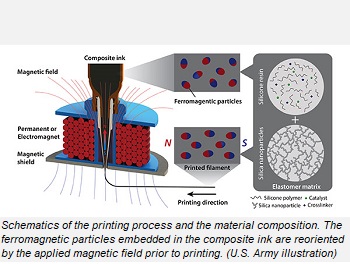
The approach is based on direct ink writing of an elastomer composite containing ferromagnetic microparticles and the application of a magnetic field to the dispensing nozzle while printing. The technique reorients particles along the applied field to impart patterned magnetic polarity to printed filaments. This method allows the researchers to program ferromagnetic domains in complex 3-D-printed soft materials to enable a set of previously inaccessible modes of transformation. The actuation speed and power density of the printed soft materials with programmed ferromagnetic domains are orders of magnitude greater than existing 3-D-printed active materials.
"We have developed a printing platform and a predictive model for others to use. People can design their own structure and domain patterns, validate them with the model, and print them to actuate various functions. By programming complex information of structure, domain, and magnetic field, one can even print intelligent machine such as robots," said MIT Professor Xuanhe Zhao, an investigator at the Army's ISN.
This work aligns with Army modernization priorities that support future Army operations through support of ARL's extramural basic research campaign and the Army's Robotic and Autonomous Systems Strategy.
The Army's ISN Mission is to help the Army dramatically improve the protection and survivability of the Soldier by working at and extending the frontiers of nanotechnology through fundamental research and transitioning with Army and industry partners.
Share on:


Testimonial
"We’re proud to call I-Connect007 a trusted partner. Their innovative approach and industry insight made our podcast collaboration a success by connecting us with the right audience and delivering real results."
Julia McCaffrey - NCAB GroupSuggested Items
What’s Next for PCB Materials? I-Connect007 Podcast Series Turns to Supply Chain Resilience
04/16/2026 | I-Connect007 Editorial TeamI-Connect007 continues its six-part podcast series with Isola experts titled, PCB Materials: The Backbone and Future of Electronics, with the release of Episode 5, which shifts focus to one of the industry’s most urgent challenges: supply chain resilience.
Indium Showcases Solder Alloy Reliability Research for Heterogeneous Integration at ICEP-HBS
04/15/2026 | Indium CorporationIndium Corporation Senior Global Product Manager, Semiconductor and Advanced Materials, Sze Pei Lim will present a collaborative International Electronics Manufacturing Initiative (INEMI) project comparing SnBi and SAC305 solder alloys for first-level interconnects in complex heterogeneous packages.
Podcast Hits the Mark in a Materials Market
04/15/2026 | Marcy LaRont, I-Connect007The base material of a printed circuit board is its literal and functional foundation. Isola, founded in 1912 in Düren, Germany, is one of the longest-standing manufacturers of glass-reinforced laminates in the electronics industry. Originally focused on insulation and fiberglass materials, the company played an early role in supplying the foundational substrates that enabled the growth of PCB technology. As electronics advanced, Isola evolved alongside the industry, expanding from basic glass-epoxy laminates into high-performance copper-clad materials and engineered prepregs.
SMTA Ultra HDI Symposium, Day 2: Fragile Supply Chains, Fierce Innovation
04/14/2026 | Marcy LaRont, I-Connect007The Arizona weather yielded another beautiful day as we gathered for the second day of SMTA’s annual UHDI symposium. After the first full day discussing the role of AI in business and the how-tos of implementation, Avondale Mayor Mike Pineda kicked off day two, proud to showcase his city and to declare its important place in the continued development of the West Valley, an increasingly important area for tech and manufacturing.
Marcy’s Musings: Operating Without a Rulebook
04/15/2026 | Marcy LaRont -- Column: Marcy's MusingsWhat happens when the rulebook is no longer useful, or worse, has not yet been written? With electronics innovation happening at warp speed, we’re increasingly asked to design and build what has no precedent, proven path, or tidy checklist to follow. “Design for invention” begins at the edge of known capability, where traditional DFM gives way to something far less certain, and far more exciting. It’s not about breaking rules for the sake of it; it’s about recognizing when the rules no longer apply and having the insight, collaboration, and courage to move forward anyway.