















 Beyond the Board: How a Diminished Supplier Base Affects Complex PCB Manufacturing Readiness in Defense
 Defense Speak Interpreted: Hypersonics Report Back After Six Years of Silence
 American Made Advocacy: American Microelectronics Power the Future of High Technology





Data Rate Increase on the International Space Station Supports Future Exploration
August 26, 2019 | NASAEstimated reading time: 2 minutes
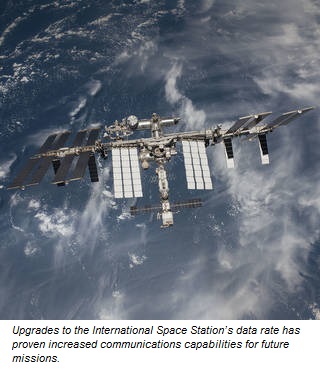
NASA recently doubled the rate at which data from the International Space Station returns to Earth, paving the way for similar future upgrades on Gateway, NASA’s upcoming outpost in lunar orbit, and other exploration missions. This new data rate will enable the space station to send back more science data faster than ever before.
NASA’s missions, both near and far, rely on quick and effective communications to relay critical mission data to control centers and scientists here on Earth. The station now supports a 600 megabit-per-second (Mbps) connection, doubling the amount of data that the station can transmit and receive at a time.
“NASA’s communications networks play a pivotal role in every NASA mission, enabling data from human spaceflight, space and Earth science research missions and technological demonstrations to reach Earth for the benefit of humanity,” said George Morrow, the acting center director of NASA’s Goddard Space Flight Center in Greenbelt, Maryland. “This increase in data rate capability for the International Space Station underlines our commitment to provide high-quality operational services for NASA exploration missions today and in the future.”
The space station’s unique environment allows astronauts to conduct research that would not otherwise be possible on Earth. These experiments and technology demonstrations are increasingly reliant on high data rates between the station and researchers on Earth. The work on the orbiting laboratory provides knowledge in human research, experience in long-duration spaceflight, and capabilities for technology demonstrations that may enable future missions. With the data rate increase, the station can now accommodate new experiments and technology demonstrations that require higher resolution or more detailed data than was previously possible.
The space station communicates with Earth through radio frequency signals using a system of Tracking and Data Relay Satellites (TDRS) and ground-based antennas called the Space Network. The TDRS are placed in a high orbit above the Earth, over various strategic locations so that they can relay data to the ground from anywhere in orbit. Landlines then send the signal to various NASA centers, and their computer systems turn the radio signal back into readable data. To send data back, the process repeats in the other direction. This happens with less than a one-second delay in communication.
“This project demonstrated that advanced radio frequency waveforms can be used efficiently to increase data rates and improve performance for high-rate communication services,” said Risha George, the upgrade project lead for the Space Network. “Operational use of these advanced waveforms proves that they can also be used for future missions, such as on the Gateway, a small spaceship that will orbit the Moon and provide a stepping stone to human exploration on Mars.”
Several components in this global communications system were upgraded to support the increased data rate, including a new digital ground architecture for the Space Network. Technicians updated the space station’s software-based modem, improved data processors at various NASA centers, and enhanced routers, interfaces and other equipment and software at the ground stations. The circuits and bandwidth of the terrestrial data lines between the various Earth-based components were also upgraded. The team then performed extensive testing to ensure the upgrades worked correctly. All of this was done while still providing real-time support to the more than 40 missions the network regularly supports.
“Partnerships like this are crucial to our continued success as an agency,” said Penny Roberts, the upgrade project lead for the space station. “Our continued partnership will transition us to 600 Mbps, and who knows where else we will go together.”
Share on:


Testimonial
"In a year when every marketing dollar mattered, I chose to keep I-Connect007 in our 2025 plan. Their commitment to high-quality, insightful content aligns with Koh Young’s values and helps readers navigate a changing industry. "
Brent Fischthal - Koh YoungSuggested Items
Global AI Optical Transceiver Market to Reach US$26 Billion in 2026
04/20/2026 | TrendForceTrendForce’s latest research indicates that the global market for AI-focused optical transceivers has entered a phase of rapid growth, with market size projected to expand from US$16.5 billion in 2025 to $26 billion in 2026, representing over 57% YoY growth.
Northrop Grumman Delivers GPS-Jamming-Resistant Airborne Navigation System
04/20/2026 | Northrop GrummanNorthrop Grumman delivered the first production unit of the EGI-M navigation system, designed to provide military users with accurate positioning, navigation and timing (PNT) data.
Molex Accelerates Supply Chain Transformation with Celonis AI
04/17/2026 | BUSINESS WIRECelonis, a global leader in Process Intelligence, announced a successful collaboration with Molex, a global electronics leader and connectivity innovator, demonstrating that process context provides the essential foundation for reliable, scalable Enterprise AI.
Molex Accelerates Supply Chain Transformation with Celonis AI
04/16/2026 | BUSINESS WIRECelonis, a global leader in Process Intelligence, announced a successful collaboration with Molex, a global electronics leader and connectivity innovator, demonstrating that process context provides the essential foundation for reliable, scalable Enterprise AI.
Controlar Introduces PicAI to Strengthen Probe Inspection in Electronics Manufacturing
04/16/2026 | ControlarControlar is bringing a new level of precision and control to electronics testing with the launch of PicAI (AI-Driven Probe Inspection Control), a fully automated system designed to replace manual ICT fixture verification in high-reliability environments.