













 It’s Only Common Sense: The Phone Is Still Your Competitive Advantage
 Dan’s Biz Bookshelf: ‘The Next RenAIssance: AI and the Expansion of Human Potential’
 The Chemical Connection: When the Industry Moves Faster Than the Standards





NASA Sounding Rocket Technology Could Enable Simultaneous, Multi-Point Measurements — First-Ever Capability
October 21, 2019 | NASAEstimated reading time: 3 minutes
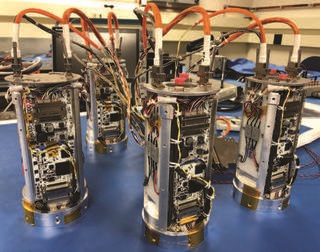
NASA engineers plan to test a new avionics technology — distributed payload communications — that would give scientists a never-before-offered capability in sounding rocket-based research. With such technology, sounding rockets could deploy multiple soda can-sized sub-payloads to varying altitudes where their onboard miniaturized instruments could gather multi-point measurements. A distributed payload communications radio receiver located on the main payload would then gather the sub-payloads’ data and multiplex them into one data stream that it would transmit to ground stations below.
This capability developed at NASA’s Wallops Flight Facility in Virginia would simplify data gathering and payload tracking, and allow scientists to study multiple regions in space simultaneously, which they can’t do with current sounding rocket technology. “Currently, most sounding rockets gather data from only one point,” said Cathy Hesh, the Wallops project manager spearheading the technology-development effort. “Our scientists want more.”
SubTEC-8 Payload
The capability is just one of several to be tested during a technology-demonstration mission known as Suborbital Technology Carrier-8, or SubTEC-8, a payload canister that Wallops engineers developed to help mature emerging technologies. SubTec-8 will be integrated onto a Terrier-Improved Malemute sounding rocket, which will launch from the Wallops Test Range in Virginia on Wednesday, October 23rd. See the NASA Wallops page for the latest.
“We took a diverse set of Wallops engineers to put this system together,” Hesh said. “It’s really an enabling technology, a technology that we’ve never been able to do before. It’s really exciting.”
Similar to AZURE
The concept is similar in nature to one that launched in April from Norway’s Andøya Space Center. During that mission, called AZURE, short for the Auroral Zone Upwelling Rocket Experiment, two Black Brant XI-A sounding rockets deployed multiple visible gas tracers containing ingredients similar to those found in fireworks. The mixtures created colorful clouds that allowed researchers to track the flow of neutral and charged particles in the auroral wind via ground-based photography and triangulation of the clouds’ moment-by-moment positions in three dimensions.
But the SubTEC demonstration will take the technology to the next level, Hesh said.
“The AZURE mission flew the same sub-payload form factor, but it carried only a tracer ampule. It did not have the telemetry avionics that we developed for these distributed payload communications,” she said, adding that these technologies, including a radio receiver, a sub-payload antenna no larger than a quarter, miniaturized transmitters, and a highly efficient power-distribution system, were developed in part with Internal Research and Development program funding at NASA’s Goddard Space Flight Center in Greenbelt, Maryland.
Within two minutes of the rocket’s lift-off, Hesh said the launch doors will open. A rocket-based release mechanism will deploy two sub-payloads equipped with university-provided instruments. These sub-payloads will travel at about 200 miles per second to a position roughly 12 miles away from the main payload. During their flight, they will measure various physical phenomena in Earth’s upper atmosphere.
A few seconds later, spring-loaded release mechanisms will deploy two additional sub-payloads, also equipped with instruments provided by another university researcher. Traveling at about 10 miles per hour to a position roughly two miles away from the main payload, these instruments will study thermal-ion plasma.
Once the sub-payloads eject, they will begin collecting and transmitting their data to the main payload receiver at a rate of about one megabits per second, Hesh said, adding the sub-payloads should get about four minutes of data before reentering the atmosphere. Following the sub-payloads’ release, the receiver on the main payload will transmit the compiled data to a telemetry station below.
“Game-Changing” Capability
Work to further improve the system is ongoing, Hesh said.
Under an FY19 IRAD, Wallops engineers Christian Amey and Brian Banks are developing a custom-made transmitter that would cost significantly less than the commercially available transmitters currently used on the distributed payload communications system. “Ultimately, we would like it to be possible to fly up to 16 to 20 of these sub-payloads in space at the same time,” Hesh said. Reducing the cost of the transmitters would make this technology more economical.
“This is a top priority for NASA’s Sounding Rocket Program,” she continued, referring to the overall distributed payload communications system. “If implemented, it would be a game-changing technology to offer the sounding rocket science community.”
Share on:



Subscribe
Stay ahead of the technologies shaping the future of electronics with our latest newsletter, Advanced Electronics Packaging Digest. Get expert insights on advanced packaging, materials, and system-level innovation, delivered straight to your inbox.Subscribe now to stay informed, competitive, and connected.
Suggested Items
Foxconn Launches Second-Gen LEO Satellite, Begins Inter-Satellite Link Testing
05/05/2026 | FoxconnFoxconn Technology Group, the world's largest electronics manufacturing services provider, announced that its second-generation low-Earth orbit (LEO) satellites, "Pearl-1A" and "Pearl-1B," were successfully launched into their designated orbits via SpaceX's Falcon 9 rocket on the evening of May 3 (Taipei time).
AdvancedPCB Advances Precision Drilling Capabilities Across Two U.S. Facilities with Schmoll
05/05/2026 | AdvancedPCBAdvancedPCB has completed the installation of two Falcon small-hole drilling systems from Schmoll Maschinen GmbH at its U.S. facilities in Maple Grove, Wisconsin and Santa Clara, California.
GlobalFoundries Advances Co-Packaged Optics for AI Data Centers with SCALE Module
05/04/2026 | GlobalFoundriesGlobalFoundries (Nasdaq: GFS) (GF) announced the introduction of its SCALE™ optical module solution for co-packaged optics (CPO).
Next Generation Microelectronics: AT&S Honors Top Apprentices
05/04/2026 | AT&SThe Austrian high-tech company AT&S is a global player in the world of microelectronics. Driven in particular by the boom in applications related to artificial intelligence (AI), IC substrates and high-tech printed circuit boards from AT&S are currently in strong demand.
Northrop Grumman Honors Top Suppliers Driving Industrial Innovation
05/04/2026 | Northrop GrummanNorthrop Grumman Corporation continues to build on its spirit of innovation, honoring suppliers who are critical partners in advancing the defense industrial base for the U.S. and its allies.