















 American Made Advocacy: Rebuilding America’s Military Stockpiles Begins With Microelectronics
 The Right Approach: The End of an Era—DoD Proposes MIL-PRF-31032 Cancellation
 Defense Speak Interpreted: Hypersonics Report Back After Six Years of Silence





NASA’s New Detectors Could Improve Views of Gamma-Ray Events
June 7, 2023 | NASAEstimated reading time: 2 minutes
Using technology similar to that found in smartphone cameras, NASA scientists are developing upgraded sensors to reveal more details about black hole outbursts and exploding stars — all while being less power hungry and easier to mass produce than detectors used today.
“When you think about black holes actively shredding stars, or neutron stars exploding and creating really high-energy bursts of light, you are looking at the most extreme events in the universe,” said research astrophysicist Dr. Regina Caputo. “To observe these events, you need to look at the highest-energy form of light: gamma rays.”
Caputo leads an instrument-development effort called AstroPix at NASA’s Goddard Space Flight Center in Greenbelt, Maryland. The silicon pixel sensors in AstroPix — still in development and testing — are reminiscent of the semiconductor sensors that allow smartphone cameras to be so small.
“Gamma rays are notoriously tricky to measure because of the way that the incoming particle interacts with your detector,” said Dr. Amanda Steinhebel, a NASA Postdoctoral Program fellow working with Caputo.
Gamma rays are wavelengths of light more energetic than ultraviolet and X rays, and their photons act more like particles than waves. “Instead of just being absorbed by a sensor like visible light,” Steinhebel said, “gamma rays bounce all around.”
NASA’s Fermi Gamma-ray Space Telescope, which has studied the gamma-ray sky since 2008, solved the “bounce” problem in its main instrument by using towers of strip-shaped sensors. This table-sized cube, Fermi’s Large Area Telescope, was itself groundbreaking technology when the mission launched.
Each strip maps a gamma-ray strike in a single-dimension, while layers of strips oriented perpendicular to each other record the second dimension. Gamma rays generate a cascade of energetic strikes through multiple layers, providing a map pointing back to the source.
About the size of a golf bag, a space telescope instrument using AstroPix sensors would require half as many layers as the Fermi strip detector technology, Caputo said.
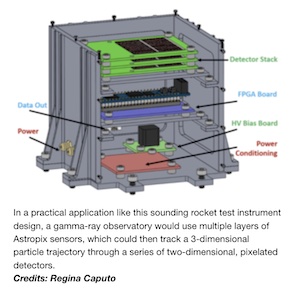
In a practical application like this sounding rocket test instrument design, a gamma-ray observatory would use multiple layers of Astropix sensors, which could then track a 3-dimensional particle trajectory through a series of two-dimensional, pixelated detectors.
“It’s easier to tell exactly where particles interact,” Steinhebel said, “because you just identify the point in the grid that it interacted with. Then you use multiple layers to literally trace back the paths that particles took through it.”
AstroPix could record lower-energy gamma rays than current technology, Steinhebel explained, because these photons tend to get lost filtering through the multiple layers of a strip detector. Capturing them would provide more information about what happens during short-lived, energetic events. “These low-energy gamma rays are most common during peak burst brightness,” she explained.
The pixel detectors also consume less electricity to operate, Caputo said, a major upside for future missions planning out their power usage.
Pixelated silicon detectors have been proven in particle accelerator experiments, she said, and their common use and mass production for cell phones and digital cameras make them easier and less expensive to obtain.
Developing different prototypes over multiple years and seeing AstroPix create accurate plots of gamma-ray light has been exhilarating and extremely satisfying, Steinhebel said.
While the team continues to work on developing and improving their technology, Caputo said the next step would be to launch the technology on a short sounding rocket flight for further testing above Earth’s atmosphere.
They hope to benefit a future gamma-ray mission intended to further the study of high-energy universe events.
“We can do such cool science with this,” Caputo said. “I just want to see that happen.”
Share on:


Testimonial
"In a year when every marketing dollar mattered, I chose to keep I-Connect007 in our 2025 plan. Their commitment to high-quality, insightful content aligns with Koh Young’s values and helps readers navigate a changing industry. "
Brent Fischthal - Koh YoungSuggested Items
GlobalFoundries Advances Co-Packaged Optics for AI Data Centers with SCALE Module
05/04/2026 | GlobalFoundriesGlobalFoundries (Nasdaq: GFS) (GF) announced the introduction of its SCALE™ optical module solution for co-packaged optics (CPO).
Next Generation Microelectronics: AT&S Honors Top Apprentices
05/04/2026 | AT&SThe Austrian high-tech company AT&S is a global player in the world of microelectronics. Driven in particular by the boom in applications related to artificial intelligence (AI), IC substrates and high-tech printed circuit boards from AT&S are currently in strong demand.
Northrop Grumman Honors Top Suppliers Driving Industrial Innovation
05/04/2026 | Northrop GrummanNorthrop Grumman Corporation continues to build on its spirit of innovation, honoring suppliers who are critical partners in advancing the defense industrial base for the U.S. and its allies.
The Missing Connection: Wire Harness Quoting Joins the Digital Age
05/01/2026 | Joanne Harris, Tech-2marketingWalk the floor of a modern wire harness manufacturing facility, and the investment in technology is hard to miss. Automated wire cutting and stripping machines process thousands of cuts an hour with sub-millimeter precision. Computerized crimping presses deliver consistent, validated terminations that a hand tool never could. Laser wire markers, automated test benches, and vision-guided assembly stations represent hundreds of thousands of dollars of capital investment, all in service of building a better harness faster and more reliably than the competition.
Everspin Executes $40M Agreement for Mil-Aero MRAM Applications
05/01/2026 | Everspin Technologies, Inc.Everspin Technologies, Inc., the world’s leading developer and manufacturer of Magnetoresistive Random Access Memory (MRAM) persistent memory solutions, announced an agreement with a U.S. prime contractor to provide state-of-the-art Toggle MRAM process technology capabilities and engineering services for United States Defense Industrial Base customers.