

















 Powering the Future: Why True Ceramic Circuits Are Not Just ‘Better PCBs’
 Global Sourcing Spotlight: The Global Quality Gap—Why Consistency Wins the Contract
 Knocking Down the Bone Pile: Precision Milling of Underfilled SMT Components





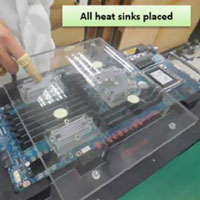
Proper assembly of components is critical in the manufacturing industry as it affects functionality and reliability. In a heat sink assembly, a detailed manual process is often utilized. However, an automated fixture is used whenever applicable. This paper will illustrate the use of strain gauge testing and finite element analysis (FEA) as a simulation tool to evaluate and optimize the heat sink assembly process by manual and automated methods.
Several PCBAs in the production line were subjected to the manual and automated assembly process. Strain gauge testing was performed and FEA models were built and run. Results were compared with the goal of improving the FEA model. The updated FEA model will be used in simulating different conditions in assembly. Proposed improvement solutions to some issues can also be verified through FEA.
Introduction
As ball grid array (BGA) package sizes continually decrease, PCB failures due to over-flexure during various assembly and test processes have been an increasing concern in the electronics industry. Board flexure control using strain gauge testing has been proven to be an effective method in analyzing different assembly processes. Strain gauges are devices whose resistance changes under the application of force or strain. In a heat sink assembly process, an automated fixture is ideal but may not always be readily available. As such, production lines have utilized operators to do the manual work. Strain gauge measurements were done to evaluate both manual and automated assembly.
An FEA assembly model was generated to assess the strain and compare with experimental data. Several iterations were made and adjusted with the goal of optimizing the FEA model. The model was used in evaluating board strain at different conditions, such as moving the BGAs at another location.
Editor's Note: This article originally appeared in the September 2015 issue of SMT Magazine.


