














 Dan’s Biz Bookshelf: ‘The Next RenAIssance: AI and the Expansion of Human Potential’
 The Chemical Connection: When the Industry Moves Faster Than the Standards
 Driving Innovation: Selecting the Right Laser Source





What New Wearable Sensors Can Reveal from Perspiration
January 29, 2016 | Lawrence Berkeley National LaboratoryEstimated reading time: 3 minutes
When UC Berkeley engineers say they are going to make you sweat, it is all in the name of science.
Specifically, it is for a flexible sensor system that can measure metabolites and electrolytes in sweat, calibrate the data based upon skin temperature and sync the results in real time to a smartphone.
While health monitors have exploded onto the consumer electronics scene over the past decade, researchers say this device, reported in the Jan. 28 issue of the journal Nature, is the first fully integrated electronic system that can provide continuous, non-invasive monitoring of multiple biochemicals in sweat.
The advance opens doors to wearable devices that alert users to health problems such as fatigue, dehydration and dangerously high body temperatures.
“Human sweat contains physiologically rich information, thus making it an attractive body fluid for non-invasive wearable sensors,” said study principal investigator Ali Javey, a UC Berkeley professor of electrical engineering and computer sciences. “However, sweat is complex and it is necessary to measure multiple targets to extract meaningful information about your state of health. In this regard, we have developed a fully integrated system that simultaneously and selectively measures multiple sweat analytes, and wirelessly transmits the processed data to a smartphone. Our work presents a technology platform for sweat-based health monitors.”
Javey worked with study co-lead authors Wei Gao and Sam Emaminejad, both of whom are postdoctoral fellows in his lab. Emaminejad also has a joint appointment at the Stanford School of Medicine, and all three have affiliations with the Berkeley Sensor and Actuator Center and the Materials Sciences Division at Lawrence Berkeley National Laboratory.
Chemical clues to a person’s physical condition
To help design the sweat sensor system, Javey and his team consulted exercise physiologist George Brooks, a UC Berkeley professor of integrative biology. Brooks said he was impressed when Javey and his team first approached him about the sensor.
“Having a wearable sweat sensor is really incredible because the metabolites and electrolytes measured by the Javey device are vitally important for the health and well-being of an individual,” said Brooks, a co-author on the study. “When studying the effects of exercise on human physiology, we typically take blood samples. With this non-invasive technology, someday it may be possible to know what’s going on physiologically without needle sticks or attaching little, disposable cups on you.”
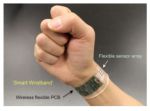
The prototype developed by Javey and his research team packs five sensors onto a flexible circuit board. The sensors measure the metabolites glucose and lactate, the electrolytes sodium and potassium, and skin temperature.
“The integrated system allows us to use the measured skin temperature to calibrate and adjust the readings of other sensors in real time,” said Gao. “This is important because the response of glucose and lactate sensors can be greatly influenced by temperature.”
Developing smart wristbands and headbands
Adjacent to the sensor array is the wireless printed circuit board with off-the-shelf silicon components. The researchers used more than 10 integrated circuit chips responsible for taking the measurements from the sensors, amplifying the signals, adjusting for temperature changes and wirelessly transmitting the data. The researchers developed an app to sync the data from the sensors to mobile phones, and fitted the device onto “smart” wristbands and headbands.
They put the device – and dozens of volunteers – through various indoor and outdoor exercises. Study subjects cycled on stationary bikes or ran outdoors on tracks and trails from a few minutes to more than an hour.
“We can easily shrink this device by integrating all the circuit functionalities into a single chip,” said Emaminejad. “The number of biochemicals we target can also be ramped up so we can measure a lot of things at once. That makes large-scale clinical studies possible, which will help us better understand athletic performance and physiological responses to exercise.”
Javey noted that a long-term goal would be to use this device for population-level studies for medical applications.
Brooks also noted the potential for the device to be used to measure more than perspiration.
“While Professor Javey’s wearable, non-invasive technology works well on sweating athletes, there are likely to be many other applications of the technology for measuring vital metabolite and electrolyte levels of healthy persons in daily life,” said Brooks. “It can also be adapted to monitor other body fluids for those suffering from illness and injury.”
The Berkeley Sensor and Actuator Center and the National Institutes of Health helped support this work.
Share on:



Subscribe
Stay ahead of the technologies shaping the future of electronics with our latest newsletter, Advanced Electronics Packaging Digest. Get expert insights on advanced packaging, materials, and system-level innovation, delivered straight to your inbox.Subscribe now to stay informed, competitive, and connected.
Suggested Items
Sikorsky, Robinson Unmanned Win U.S. Marine Corps Autonomous Logistics Contract
04/28/2026 | Lockheed MartinThe United States Marine Corps awarded a $15.5 million contract to Sikorsky, a Lockheed Martin company, for the Medium Aerial Resupply Vehicle – Expeditionary Logistics (MARV-EL) Increment 2 program.
Skoltech Team Develops Modulator for Compact Photonic Integrated Circuits
04/28/2026 | SkoltechResearchers at Skoltech have developed an ultra-compact electro-optic modulator based on silicon photonics and plasmonics that enables high-efficiency optical signal control within a small device footprint.
American Made Advocacy: Rebuilding America’s Military Stockpiles Begins With Microelectronics
04/28/2026 | Shane Whiteside -- Column: American Made AdvocacyCurrent world events demonstrate the fragility of long-distance supply chains transiting multiple zones of conflict. The U.S. military is currently drawing down supplies of key munitions and other electronic systems at unprecedented rates.1Every one of those systems is powered by printed circuit boards. The American PCB industry has kept pace with peacetime demand for the defense industry, but will now be called upon to increase production to a wartime footing at rates not seen in decades.
Call for Abstracts for Third Pan-European Electronics Design Conference
04/30/2026 | Global Electronics AssociationThe German Electronics Design and Manufacturing Association (FED) and the Global Electronics Association are officially opening the Call for Abstracts for the Third Pan-European Electronics Design Conference (PEDC).
Remtec to Showcase Advanced Ceramic Technologies and Present Thermal Management for High-Power Applications at CMSE 2026
04/23/2026 | RemtecRemtec, a global leader in advanced ceramic substrates and microelectronic assembly solutions, today announced that President and CEO Brian Buyea will lead the company’s participation at Components for Military & Space Electronics Conference & Exhibition (CMSE 2026).