















 American Made Advocacy: Rebuilding America’s Military Stockpiles Begins With Microelectronics
 The Right Approach: The End of an Era—DoD Proposes MIL-PRF-31032 Cancellation
 Defense Speak Interpreted: Hypersonics Report Back After Six Years of Silence





Robotic Drones to 'Print' Emergency Shelters for Those in Need
February 18, 2016 | Bath UniversityEstimated reading time: 2 minutes
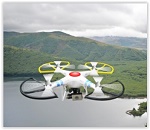
A new research project aims to develop the world's first flying robots capable of autonomously assessing and manufacturing building structures to help areas suffering from natural disasters.
The four year collaborative research project entitled ‘Aerial Additive Building Manufacturing: Distributed Unmanned Aerial Systems for in-situ manufacturing of the built environment’ involves researchers from the University of Bath, Imperial College and University College London.
Providing disaster relief
The research team aims to develop drones that can use an Additive Building Manufacturing (ABM) system to reach remote and disaster areas, and 3D print structures such as shelters and buildings, providing much needed disaster relief.
The drones being developed could fly to a disaster zone, scan and model the landscape using Building Information Management (BIM) systems, design temporary shelters, and print them on the spot. This could give those in need a place to live until emergency services personnel can reach them.
Revolutionising remote construction
ABM is a key technological building revolution currently transforming the construction industry by allowing the 3D printing of buildings and building components, resulting in quicker build times and reduced material and transport costs.
However, due to their large size, ABM systems are inflexible making it difficult for them to undertake maintenance and repair work, especially in remote and rural areas.
World's first mobile factories
Whilst many drones are used for photography and surveillance, the drones in this project will utilise a revolutionary ABM system to remotely manufacture building structures such as shelters and bridges for those in need.
In order to use this type of system for post-disaster reconstruction activities where the manufacturing speed of ABM would be hugely beneficial, the research team aims to develop the world's first ABM system consisting of a swarm of aerial robots that can autonomously assess and manufacture building structures.
To do this, the team plans to miniaturise ABM and give it aerial capabilities so that it can be more mobile and able to manufacture complex high-rise structures. This would enable the robots to act as flying mini-factories, where they would land at to a construction site and work together to create buildings from scratch.
Co-investigator and Senior Lecturer in our Department of Architecture & Civil Engineering, Dr Richard Ball said: “We are delighted to be part of this ambitious and exciting project which will push the forefront of construction technologies into the future.”
Co-investigator and Senior Lecturer in our Department of Architecture & Civil Engineering, Dr Chris Williams added: “It is exciting to be working on a project where the structure has to be so light and efficient that it can be built by small flying drones.”
The University’s Department of Architecture & Civil Engineering was ranked equal first in the UK in Architecture & the Built Environment for the high quality and international impact of its research (2014 Research Excellence Framework). In the assessment, 85 per cent of its research output was judged to be internationally excellent while 90 per cent of its research impact was judged outstanding.
Share on:


Testimonial
"We’re proud to call I-Connect007 a trusted partner. Their innovative approach and industry insight made our podcast collaboration a success by connecting us with the right audience and delivering real results."
Julia McCaffrey - NCAB GroupSuggested Items
EMAC Returns with Bright Electronics Manufacturing Challenge 2026
04/30/2026 | SMTAThe Electronics Manufacturing & Assembly Collaborative (EMAC) has announced the return of the Bright Electronics Manufacturing Challenge 2026, an immersive, hands-on student competition that puts real electronics manufacturing experience into the hands of the next generation of engineers.
Zhen Ding, Tsinghua University Launch Phase II R&D and Digital Transformation Program
04/30/2026 | Zhen DingZhen Ding Technology Holding Limited, a global leader in the PCB industry, held the launch ceremony for the Phase II (2026-2030) Industry-Academia Collaboration Program of the Zhen Ding-Tsinghua Joint Research Center at the Zhen Ding Technology Lecture Hall on the Tsinghua University campus.
SCHMID Launches 'Any Layer ET' for Panel-Level Advances Packaging, to Present at ECTC 2026
04/30/2026 | SCHMID GroupSCHMID Group, a global leader in advanced manufacturing solutions for the electronics and semiconductor industries, is advancing next-generation substrate manufacturing with its proprietary Any Layer ET (Embedded Trace) Process for full panel-level Advanced Packaging.
Hon Hai, Mitsubishi Electric Exploring Automotive Equipment Business in MOU
04/29/2026 | Hon Hai Precision Industry Co., Ltd.Hon Hai Precision Industry Co. Ltd. (Foxconn) and Mitsubishi Electric Corporation have signed a Memorandum of Understanding to explore a strategic alliance through joint operation of the automotive equipment business.
SEMIEXPO Heartland 2026 Highlights Automotive Electronics and Smart Manufacturing Innovation
04/29/2026 | SEMIThe second edition of SEMIEXPO Heartland opens this week, April 29-30 at the Detroit Marriot at the Renaissance Center in Detroit, Michigan, centered around smart manufacturing, automotive electronics, and workforce development.