















 American Made Advocacy: Rebuilding America’s Military Stockpiles Begins With Microelectronics
 The Right Approach: The End of an Era—DoD Proposes MIL-PRF-31032 Cancellation
 Defense Speak Interpreted: Hypersonics Report Back After Six Years of Silence





LPKF Equips German Armed Forces with Circuit Board Plotters
August 9, 2016 | LPKFEstimated reading time: 1 minute
More than 50 challenging civilian occupations await young people at the Bundeswehr, and electronics plays an important role in some of them.
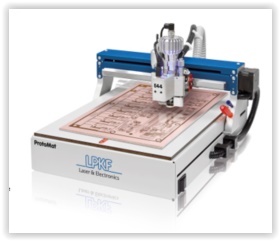
The choice of processes used demonstrates the value that the Bundeswehr trainers place on a professional setting. With over 20 newly purchased ProtoMat E44 circuit board plotters, trainers throughout Germany are relying on an environmentally friendly, chemical-free process for manufacturing single- and double-sided PCBs.
LPKF ProtoMats machine conductive patterns out of fully coated substrates by contour milling. Contact and mounting holes are then drilled. The vision system integrated in the ProtoMat E44 helps reliably detect the substrate position on the working surface to ensure that the same area is covered on the front and back sides.
Working with the mechanical milling process yields a number of advantages. The ProtoMats require little maintenance, take up little space in the development lab, and need no etching chemicals. Through the intuitive system software, trainees can quickly convert their own designs into refined PCB production prototypes.
Perfect for training and occasional PCB prototyping: Thanks to the vision system the LPKF ProtoMat E44 can also produce double-sided PCB with highest precision.
About LPKF
LPKF Laser & Electronics AG manufactures machines and laser systems used in electronics fabrication, medical technology, the automotive sector, and the production of solar cells. Around 20 percent of the workforce is engaged in research and development.
Share on:


Testimonial
"Our marketing partnership with I-Connect007 is already delivering. Just a day after our press release went live, we received a direct inquiry about our updated products!"
Rachael Temple - AlltematedSuggested Items
Global Electronics Association and CalcuQuote, an Elisa Industriq Business, Launch Joint Supply Chain Intelligence Initiative
04/29/2026 | Global Electronics AssociationThe Global Electronics Association and CalcuQuote, Elisa Industriq today announced a partnership to deliver timely, actionable supply chain intelligence for the electronics industry.
Hon Hai, Mitsubishi Electric Exploring Automotive Equipment Business in MOU
04/29/2026 | Hon Hai Precision Industry Co., Ltd.Hon Hai Precision Industry Co. Ltd. (Foxconn) and Mitsubishi Electric Corporation have signed a Memorandum of Understanding to explore a strategic alliance through joint operation of the automotive equipment business.
SEMIEXPO Heartland 2026 Highlights Automotive Electronics and Smart Manufacturing Innovation
04/29/2026 | SEMIThe second edition of SEMIEXPO Heartland opens this week, April 29-30 at the Detroit Marriot at the Renaissance Center in Detroit, Michigan, centered around smart manufacturing, automotive electronics, and workforce development.
AI Reshaping the Memory Market; Effects Spreading Across Industries
04/29/2026 | Dr. Shawn DuBravac, Global Electronics AssociationArtificial Intelligence is often framed as a software story focused on algorithms and models. But beneath that narrative lies a more fundamental shift rooted in hardware. AI is not just changing what technology can do; it’s changing how the physical components behind it are produced, allocated, and priced. One of the clearest examples of this shift is now emerging in the global memory market.
ICTC Adds Parylene Coating Capability with New KR850L System
04/28/2026 | ICTCInterconnect Cable Technologies Corporation (ICTC), a global contract manufacturer, has added in-house parylene coating capability with the installation of a new KR850L system, expanding its value-added services and giving customers a more streamlined path from build to protection.