














 Dan’s Biz Bookshelf: ‘The Next RenAIssance: AI and the Expansion of Human Potential’
 The Chemical Connection: When the Industry Moves Faster Than the Standards
 Driving Innovation: Selecting the Right Laser Source





Butterfly Wing Inspires Photovoltaics
November 15, 2017 | KITEstimated reading time: 3 minutes
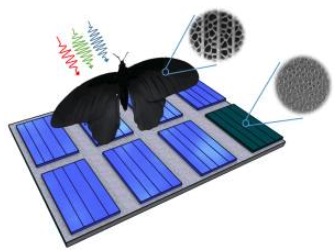
Sunlight reflected by solar cells is lost as unused energy. The wings of the butterfly Pachliopta aristolochiae are drilled by nanostructures (nanoholes) that help absorbing light over a wide spectrum far better than smooth surfaces. Researchers of Karlsruhe Institute of Technology (KIT) have now succeeded in transferring these nanostructures to solar cells and, thus, enhancing their light absorption rate by up to 200%.
Image caption: Nanostructures of the wing of Pachliopta aristolochiae can be transferred to solar cells and enhance their absorption rates by up to 200%. (Graphics: Radwanul H. Siddique, KIT/Caltech)
“The butterfly studied by us is very dark black. This signifies that it perfectly absorbs sunlight for optimum heat management. Even more fascinating than its appearance are the mechanisms that help reaching the high absorption. The optimization potential when transferring these structures to photovoltaics (PV) systems was found to be much higher than expected,” says Dr. Hendrik Hölscher of KIT’s Institute of Microstructure Technology (IMT).
The scientists of the team of Hendrik Hölscher and Radwanul H. Siddique (formerly KIT, now Caltech) reproduced the butterfly’s nanostructures in the silicon absorbing layer of a thin-film solar cell. Subsequent analysis of light absorption yielded promising results: Compared to a smooth surface, the absorption rate of perpendicular incident light increases by 97% and rises continuously until it reaches 207% at an angle of incidence of 50 degrees. “This is particularly interesting under European conditions. Frequently, we have diffuse light that hardly falls on solar cells at a vertical angle,” Hendrik Hölscher says.
However, this does not automatically imply that efficiency of the complete PV system is enhanced by the same factor, says Guillaume Gomard of IMT. “Also other components play a role. Hence, the 200% are to be considered a theoretical limit for efficiency enhancement.”
Prior to transferring the nanostructures to solar cells, the researchers determined the diameter and arrangement of the nanoholes on the wing of the butterfly by means of scanning electron microscopy. Then, they analyzed the rates of light absorption for various hole patterns in a computer simulation. They found that disordered holes of varying diameters, such as those found in the black butterfly, produced most stable absorption rates over the complete spectrum at variable angles of incidence, with respect to periodically arranged monosized nanoholes. Hence, the researchers introduced disorderly positioned holes in a thin-film PV absorber, with diameters varying from 133 to 343 nanometers.
The scientists demonstrated that light yield can be enhanced considerably by removing material. In the project, they worked with hydrogenated amorphous silicon. According to the researchers, however, any type of thin-film PV technology can be improved with such nanostructures, also on the industrial scale.
Background information:
Thin-film PV modules represent an economically attractive alternative to conventional crystalline silicon solar cells, as the light-absorbing layer is thinner by a factor of up to 1000 and, hence, material consumption is reduced. Still, absorption rates of thin layers are below those of crystalline silicon cells. Hence, they are used in systems needing little power, such as pocket calculators or watches. Enhanced absorption would make thin-film cells much more attractive for larger applications, such as photovoltaics systems on roofs.
Being ”The Research University in the Helmholtz Association“, KIT creates and imparts knowledge for the society and the environment. It is the objective to make significant contributions to the global challenges in the fields of energy, mobility and information. For this, about 9,300 employees cooperate in a broad range of disciplines in natural sciences, engineering sciences, economics, and the humanities and social sciences. KIT prepares its 26,000 students for responsible tasks in society, industry, and science by offering research-based study programs. Innovation efforts at KIT build a bridge between important scientific findings and their application for the benefit of society, economic prosperity, and the preservation of our natural basis of life.
Share on:



Subscribe
Stay ahead of the technologies shaping the future of electronics with our latest newsletter, Advanced Electronics Packaging Digest. Get expert insights on advanced packaging, materials, and system-level innovation, delivered straight to your inbox.Subscribe now to stay informed, competitive, and connected.
Suggested Items
Make the Smart Move
04/07/2026 | Stephen V. Chavez, Siemens EDAIt’s incredibly easy to become fixated on shiny new EDA software, the latest high-speed routing algorithms, or the most advanced fabrication techniques. New tools and technologies are creating sophisticated simulation platforms that automate routing, check design rules, and simulate performance. However, they cannot replicate the nuanced judgment, imaginative solutions to space constraints, or collaborative spirit that define printed circuit engineering excellence. That is your most significant return on investment.
Keysight Adds Assembly Simulation to Virtual Manufacturing Portfolio
04/06/2026 | BUSINESS WIREKeysight Technologies, Inc. announced Keysight Assembly, a new virtual process simulation solution designed to help manufacturers identify assembly issues earlier in development, before they become costly production problems.
Elsyca Acquires Hivelix to Strengthen Simulation Platform for Electrochemical Surface Engineering
04/03/2026 | ElsycaElsyca, a global pioneer in computer-aided engineering (CAE) simulation for electrochemical processes and surface finishing, announces the acquisition of Hivelix, a specialist in advanced surface treatment simulation with strong expertise in multiphysics modelling and AI-assisted process optimisation.
Aegis Software Completes Acquisition of Simio
01/27/2026 | PRNewswireAegis Software, a global provider of manufacturing execution and operations software for diverse manufacturing industries, announced that it has completed the acquisition of Simio, a leading provider of Digital Twin Simulation software and Advanced Planning and Scheduling (APS) to an attractive and resilient set of end-markets.
Pulsonix 14.0 Adds Embedded Simulation, Smarter 3D Views, Enhanced Workflow
10/08/2025 | PulsonixPulsonix, the EDA company delivering technology-leading PCB design solutions, is proud to announce the launch of Pulsonix 14.0, its latest PCB design software platform.