














 It’s Only Common Sense: Customers Capabilities—and Confidence
 Beyond the Board: How a Diminished Supplier Base Affects Complex PCB Manufacturing Readiness in Defense





WiTricity to Demonstrate Wireless EV Charging Firsts at NAIAS
September 12, 2022 | PRNewswireEstimated reading time: 2 minutes
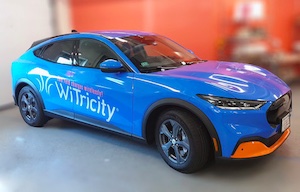
Building on the momentum of its recent investments from Siemens AG and others, WiTricity, the leader in wireless EV charging, is set to demonstrate a host of new wireless charging "firsts" at the North American International Auto Show (NAIAS) in Detroit. Attendees will experience the first-ever look at a Ford Mustang Mach-E outfitted for wireless charging; world reveal of the WiTricity Halo wireless EV charger; and can be among the first to experience WiTricity Halo with hands-on demonstrations at the Detroit Smart Parking Lab.
WiTricity will display its first 2022 Ford Mustang Mach-E upgraded with the WiTricity Halo wireless charging system at the North American International Auto Show.
WiTricity will display its first 2022 Ford Mustang Mach-E upgraded with the WiTricity Halo wireless charging system at the North American International Auto Show.
"WiTricity wants to accelerate EV adoption, which means eliminating the hassle of charging," said Alex Gruzen, CEO, WiTricity. "We have created hassle-free, end-to-end solutions for automakers, residential customers, and fleets, delivering the best charging experience for electric vehicles–just park and charge."
Ford Mach-E joins WiTricity's fleet of Tesla Model 3 EVs with upgraded charging capabilities
WiTricity will display its first 2022 Ford Mustang Mach-E upgraded with the WiTricity Halo wireless charging system. NAIAS visitors can see the simplicity of the park-and-charge experience in the vehicle pod adjacent to the company's booth in the AutoMobili-D section of NAIAS. The Mach-E joins WiTricity's upgraded fleet that includes a number of Tesla Model 3 vehicles as well as factory-installed wireless charging EVs that have been launched by OEMs in Asia.
First public reveal of WiTricity Halo wireless EV charger
WiTricity will also reveal WiTricity Halo wireless EV chargers at NAIAS. These hands-free chargers connect to the WiTricity Halo mobile app for fingertip operation and to cloud-based telemetry, performance, and charger management tools. This first model of the WiTricity Halo wireless EV charger can charge most vehicle batteries with ~35 miles of charge per hour for most newer vehicles, without the hassle and clutter of plug-in cables or stress about forgetting to plug-in. Rated at 11 kW, the WiTricity Halo charger is robust enough to be driven over and IP rated for indoor or outdoor installation.
The WiTricity Halo system also enables a range of essential features, including foreign and living object detection to turn off the charger in the event a pet or other object obstructs the product, plus parking assistance with position detection to guide drivers over the charging pad.
First-hand experience at Detroit Smart Parking Lab
In addition to all the activities at NAIAS, WiTricity will also open its showcase demonstration at the Detroit Smart Parking Lab, an open innovation platform for parking-inspired mobility technologies that was established through the collaboration of Bedrock, Ford, the Michigan Economic Development Corporation and Bosch, and operated by the American Center for Mobility. Beginning at media days and by appointment during public days, NAIAS visitors will be able to take a free shuttle to the DSPL and get a hands-on experience of the WiTricity Halo wireless EV charging system.
Share on:



Subscribe
Stay ahead of the technologies shaping the future of electronics with our latest newsletter, Advanced Electronics Packaging Digest. Get expert insights on advanced packaging, materials, and system-level innovation, delivered straight to your inbox.Subscribe now to stay informed, competitive, and connected.
Suggested Items
Remtec to Showcase Advanced Ceramic Technologies and Present Thermal Management for High-Power Applications at CMSE 2026
04/23/2026 | RemtecRemtec, a global leader in advanced ceramic substrates and microelectronic assembly solutions, today announced that President and CEO Brian Buyea will lead the company’s participation at Components for Military & Space Electronics Conference & Exhibition (CMSE 2026).
Smart Automation: The Journey of a Component Through an SMT Factory
04/22/2026 | Josh Casper -- Column: Smart AutomationIn electronics manufacturing, the SMT line tends to get most of the attention. Placement machines, inspection systems, screen printers, and reflow ovens often take center stage when discussing productivity improvements or new equipment investments. While these systems are obviously critical to the manufacturing process, they only represent a portion of the journey every component takes before becoming part of a finished assembly.
Webinar Review, Part 2: Building the AI Backbone at IBM on Systems-level Packaging
04/20/2026 | Marcy LaRont, I-Connect007The second presentation in a recent Global Electronics Association’s Executive Pulse webinar series widened the lens on advanced packaging, moving beyond the component level to a systems-level view of how AI is reshaping the electronics landscape. Building on Dr. Hemanth Dhavaleswarupu of AMD’s previous discussion of chip-level packaging innovation, Dr. Jung Yoon of IBM explored the broader infrastructure implications, from the data center floor to the global supply chain.
Cadence, NVIDIA Expand AI & Accelerated Computing Partnership
04/17/2026 | Cadence Design Systems, Inc.At CadenceLIVE Silicon Valley 2026, Cadence announced an expanded partnership with NVIDIA to deliver accelerated solutions across agentic AI, physics-based simulation and digital twins to unlock new levels of productivity and accelerate next‑generation engineering design flows across semiconductor design, physical AI systems and hyperscale AI factories.
Below the Surface: Looking Ahead to Where Integration Actually Happens
04/20/2026 | Chandra Gupta -- Column: Below the SurfaceProgress in RF rarely arrives and suddenly rewrites the rules. What actually moves performance forward almost always happens in the seams, the interfaces, the choices that determine whether individual parts are allowed to work together, or forced to fight one another. So, when we look ahead in RF systems—from DC through millimeter-wave—the most important conversations aren’t about isolated materials or heroic devices. They’re about integration, and more specifically, about how ceramic-based RF packages and module architectures shape system-level behavior long before the signal ever reaches free space.