
















 Knocking Down the Bone Pile: Precision Milling of Underfilled SMT Components
 Learning with Leo: Drones—Meeting Demand Without Compromise
 Nolan’s Notes: Our Spotlight on North America





Book Excerpt: 'The Printed Circuit Assembler’s Guide to...Process Control'
July 26, 2023 | I-Connect007Estimated reading time: 2 minutes
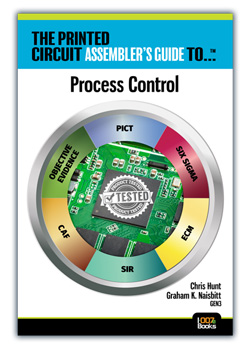
Introduction: The Printed Circuit Assembler’s Guide to...Process Control, a new book from Gen3 Systems.
An electronic assembly, by definition, has a circuit with current flowing. If by corrosion that circuit is changed, open circuit or short circuit, then the assembly will most likely be non-functional and will have failed. Dendrites are fragile metal filaments that can easily fuse when completing a circuit. Hence, an intermittent fault is observed. Continued exposure to the stress environment will cause the dendrite to regrow and cause another fault, and then fuse again. This process can repeat itself many times and, hence, many intermittent faults can be observed. Dendrites are the most common cause of No Fault Found; their intermittent nature tends to allow circuits to perform as normal, with interrupts that are not easily picked up by field return engineers who classify the product as NFF. Only when a dendrite forms a strong permanent short can it be discovered.
Susceptibility to ECM is contingent on harmful residues being present on the circuit assembly, along with other environmental factors. The creation of a water layer is a key step in ECM; this can be a sub-micron adsorbed layer, or a significantly thicker layer caused by condensation.
Figure 2.1: This visualisation (top) depicts condensation on a BGA. Release of organic acids into solution from flux residues (bottom). (Source: Mike Cummings)
Figure 2.1 depicts condensation droplets forming on the top surface of a component. As the condensation builds, at some point it will spill over the edge and then wick under the component. The right-hand images depict a flux residue encapsulating weak organic acids (WOA). When the residue is exposed to water, the WOA will dissolve into the liquid and are then available to support an electrical current. Figure 2.2 shows schematically the chemical processes occurring in ECM.
Figure 2.2: ECM processes. (Source: Mike Cummings)
Figure 2.2 depicts a condensed water layer under a BGA. Within this layer, WOA ions have been produced from flux residues. These ions migrate to the appropriate electrode supporting current flow. At the anode, anions release their charge where typically a cation is formed—in this case, a charged metallic ion. This is a corrosion process taking place at the anode. The cation migrates to the cathode, where it gives up its charge, depositing as a metal, which commonly grows as a dendrite. The figure also depicts diffusion processes and the creation of a double layer at the cathode.
The challenge, therefore, is to create a test that measures this electrical failure, where the causation has been corrosion. Such a test exists, and is the well-known SIR test, which measures resistance between electrodes. By using a SIR pattern, there is a geometric amplification of the resistance change, as well as an increased opportunity to detect a corrosion event. Within a single test assembly, the SIR test can be easily set up to provide data on specific component types. As we will see, the SIR test is the only test that truly provides objective evidence (OE).
Continue reading this book by visiting our library here.
Share on:


Testimonial
"In a year when every marketing dollar mattered, I chose to keep I-Connect007 in our 2025 plan. Their commitment to high-quality, insightful content aligns with Koh Young’s values and helps readers navigate a changing industry. "
Brent Fischthal - Koh YoungSuggested Items
RBB Earns AS9100 Certification, Expands Aerospace and Defense Credentials
05/15/2026 | RBBRBB, a trusted leader in electronics manufacturing since 1973, has achieved AS9100 certification, meeting the stringent quality, traceability, and risk management standards required in aerospace and defense industries.
yieldWerx, WATS Partner to Bridge PCB Test with Chip-Level Manufacturing Data
05/11/2026 | PRNewswireBoard-level and semiconductor test data are often analyzed separately, limiting correlation across the product lifecycle. Linking PCB assembly (PCBA) test results, including in-circuit and functional test, with upstream wafer, sort, and final test data remains difficult, particularly in photonics, advanced packaging, and high-density integration environments.
Altus Announces Return of ‘Factory of the Future’ for 2026
05/11/2026 | Altus GroupAltus Group, a leading distributor of capital equipment for electronics manufacturing in the UK and Ireland, has announced the return of its ‘Factory of the Future’ event for 2026.
Kopin Secures $21.5M Follow-On Contract for U.S.-Made Thermal Imaging Assemblies
05/06/2026 | BUSINESS WIREKopin Corporation, a leading provider of application-specific optical systems and high-performance microdisplays for defense, training, enterprise, industrial, consumer and medical products, announced it has been awarded a $21.5 million follow‑on production contract to manufacture a custom thermal‑imaging eyepiece assembly for a major U.S. defense prime contractor.
Kopin Wins $21.5M Follow-on Contract for U.S.-Made Thermal Imaging Assemblies for Defense Prime
05/05/2026 | PRNewswireKopin Corporation, a leading provider of application-specific optical systems and high-performance microdisplays for defense, training, enterprise, industrial, consumer and medical products, announced it has been awarded a $21.5 million follow‑on production contract to manufacture a custom thermal‑imaging eyepiece assembly for a major U.S. defense prime contractor.