















 The Right Approach: The End of an Era—DoD Proposes MIL-PRF-31032 Cancellation
 Defense Speak Interpreted: Hypersonics Report Back After Six Years of Silence
 American Made Advocacy: American Microelectronics Power the Future of High Technology





DARPA Taps Sikorsky to Add Autonomy to U.S. Army-Owned Black Hawk Helicopter
October 18, 2024 | Lockheed MartinEstimated reading time: 2 minutes
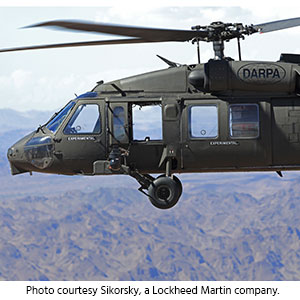
Sikorsky, a Lockheed Martin company, has received a $6 million award from the Defense Advanced Research Projects Agency (DARPA) to install the company’s ALIAS/MATRIX™ flight autonomy system onto the U.S. Army’s experimental fly-by-wire UH-60M Black Hawk® helicopter. Designated MX, the upgraded aircraft will enable the U.S. Army Combat Capabilities Development Command (DEVCOM) to test and evaluate a wide range of autonomy capabilities, from single pilot operation to fully uninhabited flight.
“Autonomy-enabled aircraft will reduce pilot workload, dramatically improve flight safety, and give battle commanders the flexibility to perform complex missions in contested and congested battlespace, day or night in all weather conditions,” said Rich Benton, Sikorsky vice president and general manager. “Soldiers will rely on Black Hawk helicopters into the 2070s, and modernizing the aircraft today will pay dividends for decades across Army Aviation’s current and future aircraft.”
The MATRIX autonomy system forms the core of DARPA's ALIAS (Aircrew Labor In-cockpit Automation System) program. As part of ALIAS in 2020, Sikorsky provided the hardware and engineering support to add fly-by-wire flight controls to the MX aircraft. When combined with the MATRIX autonomy system, the MX aircraft will be a near-exact copy of Sikorsky’s UH-60A fly-by-wire Optionally Piloted Black Hawk helicopter, the company’s flying lab that has tested MATRIX autonomy over hundreds of flight hours.
Sikorsky will integrate the MATRIX system into the MX helicopter in 2025. The aircraft will enable DEVCOM to explore and mature the practical applications and potential concept of operations of a scalable autonomy system. Evaluation will include assessment of different sensor suites to perceive and avoid threats, obstacles and terrain, and develop standards and system specifications interfaced with the MATRIX system and a fly-by-wire flight control system.
In July 2024, Sikorsky and DARPA demonstrated to U.S. military service personnel and senior Department of Defense officials how the Optionally Piloted Black Hawk helicopter can easily be flown and controlled by an operator in the cabin, or on the ground by entering high level mission goals via a tablet.
These recent demonstrations built on autonomous flights at Project Convergence 2022, when Sikorsky and DARPA successfully demonstrated to the U.S. Army how the Optionally Piloted Black Hawk helicopter, operating without humans on board, can safely and reliably perform internal and external cargo resupply missions.
Autonomous capabilities such as MATRIX technology are a key part of Lockheed Martin’s 21st Century Security® vision, which includes modernizing the Black Hawk helicopter to stay ahead of new and emerging threats.
Share on:


Testimonial
"The I-Connect007 team is outstanding—kind, responsive, and a true marketing partner. Their design team created fresh, eye-catching ads, and their editorial support polished our content to let our brand shine. Thank you all! "
Sweeney Ng - CEE PCBSuggested Items
Remtec to Showcase Advanced Ceramic Technologies and Present Thermal Management for High-Power Applications at CMSE 2026
04/23/2026 | RemtecRemtec, a global leader in advanced ceramic substrates and microelectronic assembly solutions, today announced that President and CEO Brian Buyea will lead the company’s participation at Components for Military & Space Electronics Conference & Exhibition (CMSE 2026).
Smart Automation: The Journey of a Component Through an SMT Factory
04/22/2026 | Josh Casper -- Column: Smart AutomationIn electronics manufacturing, the SMT line tends to get most of the attention. Placement machines, inspection systems, screen printers, and reflow ovens often take center stage when discussing productivity improvements or new equipment investments. While these systems are obviously critical to the manufacturing process, they only represent a portion of the journey every component takes before becoming part of a finished assembly.
Webinar Review, Part 2: Building the AI Backbone at IBM on Systems-level Packaging
04/20/2026 | Marcy LaRont, I-Connect007The second presentation in a recent Global Electronics Association’s Executive Pulse webinar series widened the lens on advanced packaging, moving beyond the component level to a systems-level view of how AI is reshaping the electronics landscape. Building on Dr. Hemanth Dhavaleswarupu of AMD’s previous discussion of chip-level packaging innovation, Dr. Jung Yoon of IBM explored the broader infrastructure implications, from the data center floor to the global supply chain.
Cadence, NVIDIA Expand AI & Accelerated Computing Partnership
04/17/2026 | Cadence Design Systems, Inc.At CadenceLIVE Silicon Valley 2026, Cadence announced an expanded partnership with NVIDIA to deliver accelerated solutions across agentic AI, physics-based simulation and digital twins to unlock new levels of productivity and accelerate next‑generation engineering design flows across semiconductor design, physical AI systems and hyperscale AI factories.
Below the Surface: Looking Ahead to Where Integration Actually Happens
04/20/2026 | Chandra Gupta -- Column: Below the SurfaceProgress in RF rarely arrives and suddenly rewrites the rules. What actually moves performance forward almost always happens in the seams, the interfaces, the choices that determine whether individual parts are allowed to work together, or forced to fight one another. So, when we look ahead in RF systems—from DC through millimeter-wave—the most important conversations aren’t about isolated materials or heroic devices. They’re about integration, and more specifically, about how ceramic-based RF packages and module architectures shape system-level behavior long before the signal ever reaches free space.