
















 Knocking Down the Bone Pile: Precision Milling of Underfilled SMT Components
 Learning with Leo: Drones—Meeting Demand Without Compromise
 Nolan’s Notes: Our Spotlight on North America





Building Industry-ready Talent Through Standards-based Education
April 27, 2026 | Global Electronics AssociationEstimated reading time: 2 minutes
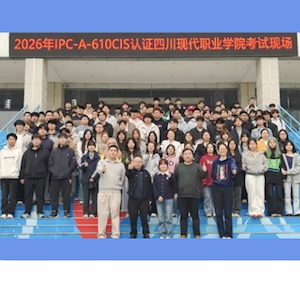
Recently, Sichuan Modern Vocational College organized 132 students to complete IPC-A-610 Acceptability of Electronic Assemblies Certified IPC Specialist (CIS) training and certification. This single-session certification cohort sets a new benchmark for similar programs among vocational institutions. The large-scale certification initiative marks a significant step in embedding IPC standards into the college’s regular teaching system, representing a dual breakthrough in standardized education and scalable application, and providing a solid foundation for aligning vocational education with industry needs.
As the electronics manufacturing industry accelerates toward higher quality and reliability, demand for skilled talent has evolved from single-skill proficiency to a more comprehensive capability encompassing standards understanding, hands-on skills, and quality control. In response to these shifting workforce requirements, Sichuan Modern Vocational College has proactively aligned with industry trends by introducing IPC standards-based courses and certification programs. By integrating widely recognized industry standards throughout the talent development process, students are able to better align with real-world job requirements during their studies and acquire essential standards knowledge and practical skills in advance.
During implementation, the college tailored its approach based on program characteristics and curriculum design, adhering to the principle of integrating standards into teaching and aligning training with job requirements. IPC standards were systematically incorporated into practical training and coursework, establishing an integrated training model that combines theoretical instruction, hands-on practice, and certification assessment. Through structured training, professional guidance, and rigorous certification processes, the program ensures close alignment between academic content and enterprise requirements. This approach addresses the longstanding gap in vocational education that often emphasizes skills over standards, making teaching more relevant to real production scenarios, effectively shortening students’ transition period from campus to workplace, and laying a solid foundation for career readiness.
Sydney Xiao, President of the East Asia Region at the Global Electronics Association, highly praised the initiative, “Introducing international industry standards into academic programs is a key step in aligning talent development with industry needs. Compared with providing standards training only after graduates enter the workforce, equipping students with standards knowledge and application capabilities during their studies not only reduces training costs for enterprises, but also enables graduates to adapt more quickly to job requirements and achieve stronger career development.”
The IPC Education Partner Program continues to expand the introduction of standards-based courses and certification across various institutions, supporting the high-quality development of vocational education. Looking ahead, IPC China will further deepen collaboration with leading institutions, promote broader integration of IPC standards into academic systems, and cultivate more highly skilled talent aligned with industry needs, thereby strengthening the talent pipeline for the sustainable development of the electronics manufacturing industry.
For more information about IPC China Education Partners, please visit: www.ipc.org.cn/about/partners
Share on:


Testimonial
"The I-Connect007 team is outstanding—kind, responsive, and a true marketing partner. Their design team created fresh, eye-catching ads, and their editorial support polished our content to let our brand shine. Thank you all! "
Sweeney Ng - CEE PCBSuggested Items
RBB Earns AS9100 Certification, Expands Aerospace and Defense Credentials
05/15/2026 | RBBRBB, a trusted leader in electronics manufacturing since 1973, has achieved AS9100 certification, meeting the stringent quality, traceability, and risk management standards required in aerospace and defense industries.
New Courses: Advance Your Electronics Expertise in June and July
05/14/2026 | Global Electronics AssociationStay current with design, manufacturing, and quality standards by enrolling in one of these online instructor-led courses starting in June and July from ElectronicsU at the Global Electronics Association, designed to help professionals at every level sharpen their skills and advance their careers. These live, expert-led sessions combine flexibility with real-time interaction, allowing participants to learn directly from seasoned industry professionals while collaborating with peers worldwide. Access to all applicable IPC standards is included in the courses.
Nokia, Lockheed Martin Launch Mission-Critical 5G Solution for U.S. Defense Standards
05/11/2026 | Lockheed MartinNokia Federal Solutions and Lockheed Martin announced the launch of a new modular, open‑architecture 5G solution built for the U.S. and allied defense forces.
The Chemical Connection: When the Industry Moves Faster Than the Standards
04/29/2026 | Don Ball -- Column: The Chemical ConnectionAs a supplier of wet processing equipment, we have rules and standards we must adhere to, including both regional and national electrical codes and safety and environmental regulations, as well as myriad other standards to make the equipment safe to use. Things are a little different when it comes to rules and standards for manufacturing PCBs, though, because technical advances and requirements change so quickly that standards can’t keep up.
UHDI Fundamentals: Standardization, Workforce, and the Road Ahead for Flex-Packaging Integration, Part 3
04/22/2026 | Anaya Vardya, American Standard CircuitsParts 1 and 2 of this series established the technical foundation and application landscape for the convergence of flexible PCBs and advanced semiconductor packaging. Part 3 addresses what comes next: the standards frameworks, talent pipelines, and strategic imperatives that will determine whether the industry can scale this convergence reliably and competitively.