















 Powering the Future: Why Thermal Management Defines the Future of Electronics
 Standard of Excellence: Engineering Is the New Sales—How Technical Collaboration Wins Business
 SMT Perspectives & Prospects: Artificial Intelligence, Part 7—Data Module 2





Sandia Research Seen to Boost R&D into Thin Films
May 23, 2016 | Sandia National LaboratoriesEstimated reading time: 4 minutes
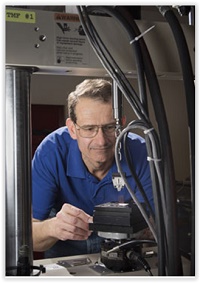
Sandia National Laboratories researcher Paul Vianco sees his work on thin films as a poster child for the way research and development based on nuclear weapons work can boost U.S. industry.
Since the 1970s, laboratories researchers have taken studies originally performed to support the weapons program and published or presented parts of the work at technical conferences. Vianco calls that passive tech transfer.
“Engineers would just fill rooms. They wanted to hear what we were doing, not only because our research represented the ‘latest-and-greatest,’ but more so because it was applied technology,” he said. “This was information that folks ate up because they could take it back to their companies and put it directly to use on their products.”
Vianco recently won the Surface Mount Technology Association’s 2015 Best of Proceedings award for the paper: “Establishing a Ti-Cu-Pt-Au Thin Film on Low Temperature Co-Fired Ceramic Technology for High-Temperature Electronics.” Co-authors were Jerome Rejent, Alice Kilgo, Bonnie McKenzie and Amy Allen of Sandia; recent Sandia retiree Mark Grazier; and William Price of the Kansas City National Security Campus (KCNSC) and Esteban Guerrero, now retired from KCNSC. The winners of the Best Papers awards will be honored Sept. 27 at the association’s conference in Rosemont, Illinois. Vianco also won the Best of Proceedings paper in 2012.
Thin films are nanometer-thick layers of metal that can be defined into precision electrical circuits similar to traditional printed circuit boards. Instead of a laminated or built-up copper conductor circuit, a thin film is patterned into a circuit through photolithography techniques. The benefit is miniaturization with finer lines and spaces, so the electronic component can be made smaller and do more at the same time.
“Smaller components weigh less and use less power,” said Vianco, who works in Sandia’s metallurgy and materials joining group. “We reduce what industry refers to as ‘SWaP,’ or size, weight and power.”
Data could be used to further develop components
Sandia’s paper provides the electronics industry with data that can be used to further develop thin film-on-low temperature co-fired ceramic (LTCC) components — called hybrid microcircuits — for high-temperature electronics. Vianco envisions a new generation of such LTCC components that will combine miniaturization, functionality and the ability to withstand harsh environments, and which are fabricated by commonly used photolithography processes.
“The solder interconnection reliability data will enable use of these products in applications that include down-hole oil and gas exploration as well as renewable energy development,” Vianco said. Such hybrid microcircuits also have significant potential for sensors and communications electronics in space probes, he said.
Sandia has been collaborating with the Kansas City National Security Campus since its breakthrough development of LTCC technology on thin film a few years ago. The research was funded by the nuclear weapons life extension program at Sandia as well as Sandia’s and KCNSC’s Enhanced Surveillance Campaigns, which support stockpile stewardship. KCNSC built the LTCC and deposited the thin films, while Sandia developed and implemented test procedures and used its advanced microanalysis capabilities for failure mode analyses.
Vianco praised the collaboration.
“It’s really a case where we took the application, understood what information was needed to ensure producibility and reliability of the solder interconnections and developed a test in collaboration with our KCNSC partners. The result was strength and failure analysis information that significantly enhanced the ability of Sandia to design new components and of KCNSC to fabricate them into high-reliability products,” he said. “We’ve sort of come full circle: We identified the need, developed an experiment and obtained test data that supported the application. Publishing the results made the data available to the U.S. electronics industry.”
Work offers electronics industry new applied technology
The award-winning study evaluated the mechanical properties of solder joints made to a thin film conductor pattern deposited on the surface of an LTCC substrate. Co-fired means individual layers, stacked on one another, are fired together at high temperatures to create the internal, multilayer circuitry and interconnections that are hallmark LTCC technology. Vianco and colleagues developed a standard method to assess solder joint strength on the advanced thin film circuits. The approach provides a way to define assembly processes and determine the long-term reliability of solder interconnections for critical, high-frequency components.
“Thin film conductors are not a new circuit technology, but they are still in relative infancy within the high-reliability electronics industry,” Vianco said. “A lot of hybrid microcircuits still rely upon the old thick film conductor technology, which uses screen or stencil printing to define the electrical circuit. We’ve used it for years on high-frequency components. But it’s limited in terms of achieving better SWaP for those products because we can’t miniaturize it very much more than we’ve already done.”
The electronics industry wants to improve product performance, but often hasn’t fully appreciated the intricacies of interconnections-plus-thin films as a materials system, he said. “It’s been kind of a mystery in terms of how solder joints made to thin film conductors stay attached to the LTCC substrate, but I think they now see that what we’re doing is valuable in furthering this technology. For those who never thought of using thin film-on-LTCC, those folks are saying, ‘Maybe now we do know enough about this technology to try it on our products.’”
Share on:


Testimonial
"Advertising in PCB007 Magazine has been a great way to showcase our bare board testers to the right audience. The I-Connect007 team makes the process smooth and professional. We’re proud to be featured in such a trusted publication."
Klaus Koziol - atgSuggested Items
SMTA Ultra HDI Symposium, Day 2: Fragile Supply Chains, Fierce Innovation
04/14/2026 | Marcy LaRont, I-Connect007The Arizona weather yielded another beautiful day as we gathered for the second day of SMTA’s annual UHDI symposium. After the first full day discussing the role of AI in business and the how-tos of implementation, Avondale Mayor Mike Pineda kicked off day two, proud to showcase his city and to declare its important place in the continued development of the West Valley, an increasingly important area for tech and manufacturing.
KYZEN Focuses on Aqueous and Stencil Cleaning Solutions at SMTA Monterrey Expo and Tech Forum
04/10/2026 | KYZEN'KYZEN, the global leader in innovative environmentally friendly cleaning chemistries, will exhibit at the SMTA Monterrey Expo & Tech Forum.
Solder Paste Innovations for Enhanced Reliability from MacDermid Alpha Electronics Solutions
04/10/2026 | Real Time with... APEX EXPOJason Fullerton of MacDermid Alpha Electronics Solutions discusses innovative alloys like Innolot MXE, low-temperature solder options, and polymer reinforcement strategies. Learn how these solutions address the growing demands of high-performance computing and larger component assemblies, ensuring optimal performance and cost-effectiveness.
Frank Sommer Discusses Selective Soldering Innovations for EVs
04/10/2026 | Real Time with... APEX EXPODan Beaulieu sits down with Frank Sommer, a selective soldering expert from Nordson Electronics Solutions, to discuss the resurgence of selective soldering driven by electric vehicle manufacturing, and the need for robust through-hole component integration. He also introduces Nordson's innovative SELECT Synchro selective soldering machine, designed for enhanced throughput and flexibility.
Double Win: Indium Corporation’s CW-807RS and Indium12.9HF Receive EM Asia Innovation Honors
04/07/2026 | Indium CorporationIndium Corporation®, a leading materials provider for the electronics assembly market, recently received Electronics Manufacturing (EM) Asia Innovation Awards for its halogen-free CW-807RS flux-cored wire and Indium12.9HF solder paste products.