














 Dan’s Biz Bookshelf: ‘Abundance: How We Build a Better Future’
 Trouble in Your Tank: In Complex Systems, Design Rules Aren’t Optional
 It’s Only Common Sense: The Phone Is Still Your Competitive Advantage





From Afterschool Robotics Club to FIRST Competitions
August 11, 2016 | Barry Matties, I-Connect007Estimated reading time: 4 minutes
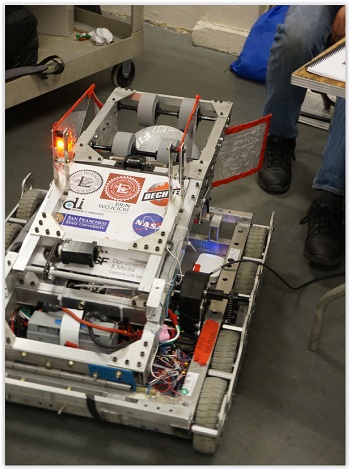
Seven years ago, Joel Bruxvoort, a science teacher at Jefferson High School in Daly City, California, started a robotics club as an afterschool program. Now, his club has two teams competing in events for FIRST (For Inspiration and Recognition of Science and Technology), an international youth organization developed to advance STEM subjects around the world. I met up with Joel at the San Mateo Maker Faire to find out what it takes to coach and a run a robotics team.
Barry Matties: Joel, I was talking to Ken Johnson and Jill Wilker earlier about how the FIRST program is reaching into the public school curriculum. Why don't you tell me a little bit about your experience with it?
Bruxvoort: I have a robotics club that I run multiple teams off. This is my seventh year doing it, and it started as an afterschool club. It still is mainly an afterschool club, but I am also getting ready to start teaching it for the first time as a UC-approved elective class. I’m looking forward to that.
Matties: In terms of the club, how many of the students are there?
Bruxvoort: I have about 25 students actively involved in the club on one to two teams. Right now I have two teams at the Maker Faire and two robots on the field.
Matties: Do the students start from the ground up and build the robots?
Bruxvoort: Yes, it's very important to get those basic skills, all the way from using tools and basic programming skills, to give them as much experience as they can at all different levels. I really like having multiple years with the kids, because if they’re hesitant on something, I can teach them, get them confident and build up their skills over time.
Matties: How is your program funded?
Bruxvoort: We have one benefactor who gives us a couple thousand dollars a year. Then we do our own fund-raising. As a teacher, I also get a stipend for running the club.
Matties: How much money on an annual basis does it take to run a club with 25 students?
Bruxvoort: It depends on what you want to do. My first year, I ran the club for less than $2,000. This year, I'm investing in buying equipment, getting a whole new set of computers, and building up that. I've been investing in the field and in hardware. My fundraising is better this year, so I'm going to be spending about $7,000 on the club.
Matties: And that gives you a good foundation of technology and building materials?
Bruxvoort: Yes, exactly. Now I really have the capability of having probably three teams fully functional with everything they need within that. Computers are available and basic shop tools, which I've been building up over time as well.
Matties: Does the school give you space to operate your club?
Bruxvoort: As a physics teacher, I've been able to operate out of my classroom; but we just got a new science building and there is a room that’s been given to me so the club actually has a robotics room. That room will transition as the robotics space next year. Also, the plan is to have a Maker class come in, so it will be a shop for robotics and making.
Matties: This is great, because the cost of higher education, obviously, is not achievable for everybody. To give the foundation of these skills at such an early age, you're changing kids' lives, actually. So we've talked about the mechanics and the financial side. Tell me a little about the impact on the kids. What do you see?
Bruxvoort: I see tremendous growth in what the kids can do. Robotics is appealing to some who want to go and do it. Also, there's a lot of scary things about it. What's nice and what I like about FTC (FIRST TechChallenge, one of the four FIRST programs) is it's very approachable. It's meant to be trial and error, so you can get in and explore something new, and fix it if it doesn't work. That iterative process of learning allows the students to try something new, and the cost of failure isn't too high. That's really good.
Matties: In terms of their confidence and self-esteem in this area, how's that?
Bruxvoort: They build skills, which takes them to the next level. They can try things, and they learn, and then they can try something more complicated. There's always a new cycle of kids who've never touched programming. I can introduce them to the basic ones, and then when they master that, they've got that strength to build to the next one.
Matties: That's great. It seems like it is more than just robotics.
Bruxvoort: It's not just robotics; there's the whole engineering notebooks to get the students thinking as an engineer. There is a design part, and there's outreach capabilities, so the kids are getting out of the classroom, going to events, or talking to other groups. We go to the library, we go to schools, and we're here at the Maker Faire. The kids get to talk and explain what's going on about the program, and they get better and better as we keep doing it. It's a lot of fun to see.
Matties: I really appreciate you spending time with us, sharing. Are there any closing thoughts that you want to share?
Bruxvoort: I have to say it's just a great program, because you can get started easily and then just grow from there.
Matties: Great. Thank you so much.
Bruxvoort: Thanks.
Share on:


Testimonial
"Our marketing partnership with I-Connect007 is already delivering. Just a day after our press release went live, we received a direct inquiry about our updated products!"
Rachael Temple - AlltematedSuggested Items
When Quality Is Personal: The Human Stakes Behind Electronics Reliability
05/06/2026 | Kelly DackIn electronics manufacturing, quality is often discussed in terms of specifications, standards, and process controls, but as industry veteran Doug Pauls reminds us, the stakes are far more human. In this conversation, Doug, a recipient of the Global Electronics Association’s Hall of Fame Award, draws on more than four decades of experience to illuminate the real-world consequences of reliability, where even a single defect can carry profound implications. He brings into sharp focus why quality isn’t just a metric, but a responsibility shared by everyone on the manufacturing floor.
PCBAA, AAM Take on the Fight to Rebuild U.S. Manufacturing in New Documentary
05/05/2026 | Marcy LaRont, I-Connect007Throughout most of the 20th century, manufacturing was central to the American Dream of providing stable jobs and pathways to upward mobility. Today, more than 80% of global electronics manufacturing capacity resides in China and greater Asia, raising serious concerns about supply chain resilience and national security.
India’s Vasantha Advanced Systems: EMS Success for 30 Years
04/22/2026 | Marcy LaRont, I-Connect007Based in one of India’s premier manufacturing regions, Vasantha Advanced Systems is an EMS provider that has built a reputation for quality, reliability, and long-term customer partnerships, earning repeated recognition from the Indian government through its National MSME Awards. Now, with a full spectrum of capabilities spanning PCB assembly, box build, and wire harness, and a workforce of more than 500, Vasantha is expanding its presence into the U.S. market. At APEX EXPO, I met Dr. Chidambaranathan and learned how this rising global player is positioning itself to meet the evolving needs of North American customers.
April Issue of I-Connect007 Magazine: Beyond the Rulebook
04/14/2026 | I-Connect007 Editorial TeamIn this month’s I-Connect007 Magazine, we asked PCB designers, fabricators, and suppliers what it really means to operate without a rulebook. Their perspectives vary, especially between seasoned designers and experienced fabricators, but a common thread emerges: progress depends on pushing boundaries and finding a way forward, even when the path isn’t clear. In many ways, this mindset has always been part of what we do, whether we’ve called it that or not.
Defense Speak Interpreted: Hypersonics Report Back After Six Years of Silence
04/07/2026 | Dennis Fritz -- Column: Defense Speak InterpretedIt’s been six years since my Defense Speaks column about hypersonic weapons. Back then, these weapons were the most sought-after technology as there was little defense for them. They were the cornerstone of the “strike any location on earth within one hour” scenario. Of course, the war in Ukraine, and now the action in Iran, have grabbed the weapons headlines, but hypersonics still play a role and development continues. Here is the update.