

















 Bridging the Pacific: What American and Asian PCB Companies Can Learn From Each Other
 Learning With Leo: The Study of Listening
 Nolan’s Notes: Automotive Is Gearing Up Again





There has been an increasing amount of discussion on low-temperature soldering, and solder pastes. And why not? There are several advantages of using low temperature solders—from a technical standpoint and economic perspectives.
First, it will reduce the stress on components and substrates on boards. Low-temperature soldering will lower the energy costs of your reflow ovens, as well as reduce material costs for your assemblies, as you may switch to cheaper substrates and packages. It will also help reduce the warpage of flip chip BGAs for the latest generation of microprocessors, thereby increasing SMT yields.
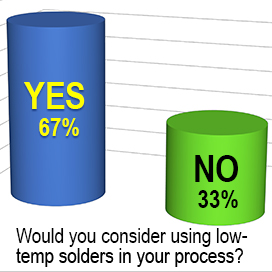
One question in a recent survey by I-Connect007 on soldering is about the use of low-temperature solders in the assembly process.
According to the results of our survey, majority, or 67% of the respondents will consider using low-temperature solders in their assembly process. Chief among their reasons include less damage to components and the PCB, reduced stress from the CTE mismatch on cooling from reflow, and "because it makes sense."
Those who answered “No”, on the other hand, point to the unpredictability and uncertainty of low-temperature solders in terms of long-term reliability. One respondent noted that low-temperature soldering tends to cause weak soldering connections as well as insufficient heat and time for the flux activation process to take place, thereby impacting the overall reliability of the assembly.
To know more about the results of the survey, look out for the upcoming issue of SMT007 Magazine.


