











 It’s Only Common Sense: How AI Consumes the Electronics Supply Chain
 Dan’s Biz Bookshelf: ‘Building a Story Brand 2.0’





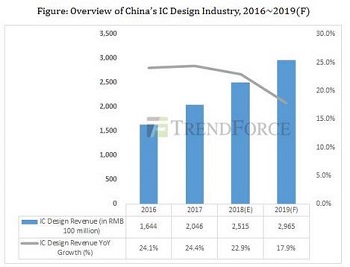
According to the latest report of TrendForce- Breakdown Analysis of China’s Semiconductor Industry, the revenue of China’s IC design industry reached RMB 251.5 billion in 2018, an annual growth of nearly 23%. HiSilicon, Unisoc, and Beijing OmniVision Technologies ranked top three in the 2018 revenue ranking. Looking ahead to 2019, China will continue to seek chip self-sufficiency, driving the growth of domestic IC design industry. The revenue is expected to total RMB 296.5 billion, but the YoY growth rate is moderated to 17.9% due to a series of headwinds, including the weak demand outlook for consumer electronics, the slowdown in global economy, and uncertainties brought by the U.S.-China trade war.
In TrendForce’s 2018 revenue ranking for China-based IC design houses, three of the top ten recorded over $US 1 billion in revenue, three recorded outstanding performance with annual growth rates over 20%, while two experienced double-digit decline.
To be more specific, HiSilicon recorded annual revenue growth of almost 30% due to strong smartphone sales of Huawei, the parent company of HiSilicon, as well as the increasing penetration rate of Kirin chips in smartphones. Galaxycore also registered a strong growth of 39% in revenue, benefiting from robust demand for CIS and increased chip prices. GigaDevice’s revenue growth totaled 13%, driven by price hike of Nor Flash in the first half of 2018 and increased revenue from its MCU business. Unigroup Guoxin Microelectronics, on the other hand, witnessed around 28% growth in revenue thanks to rapid expansion of its smart secure chip business.
In terms of Sanechips ZTE (Microelectronics) and Goodix, they experienced a double-digit decline during the past year. Sanechips ZTE’s revenue in 2018 was nearly 20% lower than that in 2017 due to negative influences from ZTE ban. Goodix was affected by decreased shipments of fingerprint chips and falling chip ASP, thus witnessed a revenue decline of around 13%.
China’s IC design industry has made constant progress in 2018, with a few of them taking a leading role in the 5G baseband chip and AI chip market. For example, HiSilicon has already mass produced the world’s first 7nm SoC, while several companies including Baidu, Huawei, Cambricon Technologies, and Horizon Robotics launched new AI chips for end applications and cloud. However, China’s IC chip self-sufficiency rate remains only 15% at the current stage. China has been reducing the reliance on mainly entry-level and low-priced chips, but for high-end ones, there remains a large room for improvement. In the future, it is still necessary for Chinese chipmakers to strengthen R&D, in order to increase the self-sufficiency rate of mid- and high-end chips, and to fuel constant revenue growth.
Looking ahead to 2019 and afterward, TrendForce believes that AI, 5G, AIOT, autonomous, edge computing, biometric, etc. will continue to be hot topics in the high-tech industry, which would also lead to changes in the industry landscape. China has taken the lead in the aforementioned key technologies, which would drive the constant development of China's IC design industry.
Regarding the development of 5G, the roll-out of 5G for commercial purposes would create new application scenarios in the future, triggering demand for semiconductor components, says TrendForce. As most areas of the world enter the commercialization of 5G in 2020, the demand for semiconductors is expected to rise since around 2021. In addition, 5G has been adopted in commercial AIOT fields, while industry leaders, telecom companies, and governments play an important role in the commercialization of this new technology, which can reveal the potential business opportunities in niche markets.
Moreover, in the market of automotive electronics, car electrification and smart connected cars have been advocated by government and industry giants. Despite the decline in overall car sales, the increasing penetration rate of vehicle electrification and smart connected cars will gradually drive the demand for semiconductor components.


