














 Bridging the Pacific: What American and Asian PCB Companies Can Learn From Each Other
 Learning With Leo: The Study of Listening
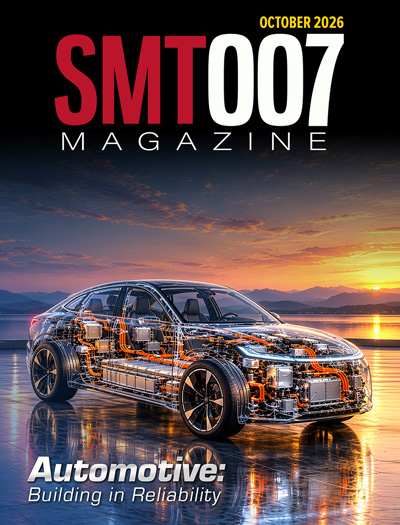
 Nolan’s Notes: Automotive Is Gearing Up Again





Müller: Business is good. Sometimes, journalists say, “There are rumors that the business is pretty weak at the moment and people are nervous, especially from the automotive industry.” But my impression is that the electronics industry especially is stronger than before. Even if there are some new changes in the automotive industry, such as electromobility, this is one thing that strengthens the electronics industry we work in, so business is good, and the forecast is better than before.
Matties: As we see autonomous vehicles coming into play, a lot more technology is going into cars.
Müller: And this is one thing we profit from because we have our automotive business unit. Goepel electronic also offers test systems for ADAS components in the driver assistance systems, such as frame grabbers and generators—which test the cameras and the sensors of a car and is becoming more and more important in the vehicle—excommunication, and vehicle-to-vehicle communication. More electronics, sensors, and cameras have to be tested, and the communication between all of these components has to be tested, which is strengthening our business in the automotive industry.
Matties: I would think that there’s a growing demand, even if car sales themselves may be dipping in some regions, because this technology is being driven by 5G.
Müller: Yes, this is a big topic coming up and, as we’ve heard before, communication between cars and the environment is growing extremely fast. Right now, it’s under development at all the manufacturers, and during the next 10–20 years, we will have huge growth in this special sector.
Matties: I think you’re absolutely right, and with 5G, right now, the average person might have 3–5 connections to the internet. But in the coming years, we’re going to see hundreds of connections per individual. It’s going to be in their refrigerator, cars, lawn mowers, etc.; everything is going to be connected to the internet.
Müller: Right. Everything will be connected and have a connection to the internet from home to cars, companies, and the industry we’re working in where every machine will be connected. I think the automotive industry is the most interesting. The smart home is not as critical as the automotive sector because of the danger that can occur in the vehicles.
Matties: And it’s interesting when you look at the mix of cultural differences. In China, for example, it seems that everybody is using e-pay. Very few are using currency. I went to buy some vegetables at a fruit stand, and they would not even take my cash; in America, we’re slow to adopt that because we’ve grown up with the illusion of privacy. So, there are cultural differences influencing the adoption of certain technologies that we see happening in the world.
Müller: It’s changing right now. I just started using Google Pay, and when it works, it’s easy. But if you’re thinking about using cash and never having any, what’s left of your money? It’s just numbers on your cellphone or in your bank account, and you have nothing in your hand. I think the young generation is growing with these issues now. I can’t imagine my grandparents using Google Pay or PayPal.
Matties: It’s always nice to catch up with you. Thanks so much.
Müller: Thank you, Barry.
Page 2 of 2


