













-
- News
- Books
Featured Books
- smt007 Magazine
Latest Issues
Current Issue
Spotlight on North America
A North America spotlight exploring tariffs, reshoring, AI demand, and supply chain challenges. Plus, insights on cybersecurity, workforce development, and the evolving role of U.S. electronics manufacturing.
Wire Harness Solutions
Explore what’s shaping wire harness manufacturing, and how new solutions are helping companies streamline operations and better support EMS providers. Take a closer look at what’s driving the shift.
Spotlight on Europe
As Europe’s defense priorities grow and supply chains are reassessed, industry and policymakers are pushing to rebuild regional capability. This issue explores how Europe is reshaping its electronics ecosystem for a more resilient future.
- Articles
- Columns
- Links
- Media kit
||| MENU - smt007 Magazine
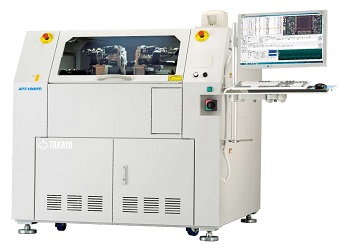
Takaya Launches Fastest Dual-Sided Flying Probe Tester
July 9, 2019 | TakayaEstimated reading time: 1 minute
Takaya’s APT-1600FD Advanced Flying Probe test system for assembled PCBAs provides average head-speed increases of up to 50% with throughput improvements of 30-50% over existing models, making it the industry’s fastest flying-probe test system. The APT-1600FD incorporates a new 10-flying-Z-axis design, including four vertical flying probes that provide unequalled access to test points where conventional angled probes fail to contact.
The APT-1600FD is the newest member of Takaya’s APT-1400F family of flying probers. Its six top-side and four bottom-side flying probes deliver unprecedented speed and performance found only from Takaya, the inventor and industry leader in flying-probe test technology for more than 25 years.
Takaya’s “soft touch” probing virtually eliminates the presence of witness marks often associated with flying probe test. To help compensate for board warpage, the system now comes equipped with a laser profiling system. Prior to testing a PCA, the surface of the board is scanned and the system automatically compensates for any warpage, guaranteeing maximum probing accuracy.
Next generation, high-precision measurement electronics are embedded in the flying heads allowing for greatly improved measurement accuracy and increased functional capabilities. The new measurement system includes multiple 4-quadrant source and measurement units, plus an AC sine and square wave generator and frequency counter, providing the ability to perform dynamic characteristic tests of components and circuits. An Enhanced Function Scanner Board and communications software make it easy to connect external instrumentation for additional functional-test capabilities.
About TEXMAC
TEXMAC, the exclusive authorized distributor of TAKAYA flying prober test systems in North America, is based in Charlotte, North Carolina, and offers a full range of sales and support services including test and programming services. Locations include facilities in the Boston, Chicago, Dallas, and Silicon Valley areas.
Testimonial
"Advertising in PCB007 Magazine has been a great way to showcase our bare board testers to the right audience. The I-Connect007 team makes the process smooth and professional. We’re proud to be featured in such a trusted publication."
Klaus Koziol - atgSuggested Items
Kymeta Joins Red Cat Initiative for Maritime Connectivity
05/15/2026 | Globe NewswireRed Cat Holdings, Inc. , a U.S.-based provider of advanced all-domain drone and robotic solutions for defense and national security, announced that Kymeta, a world-leading flat-panel satellite terminal manufacturer, has joined the Red Cat Futures Initiative, the company’s industry-wide consortium accelerating advanced autonomous systems for modern warfare.
SPARK Microsystems Selected for CAD $1M in Government of Canada-backed FABrIC Funding
05/14/2026 | BUSINESS WIRESPARK Microsystems, a Canadian fabless semiconductor company specializing in next-generation short-range wireless communications, has been selected by FABrIC as a CAD $1 million grant recipient funded by the Government of Canada.
System Architecture Beyond the Die With Advanced Packaging as the Scaling Factor
05/14/2026 | Chetan Arvind Patil, Marvell TechnologyIn conventional monolithic semiconductor design, system integration was achieved within a single die and constrained by reticle limits. Compute cores, cache, memory controllers, and input output (I/O) interfaces were all co-optimized on a single process node, with performance closely tied to transistor density and on-die interconnect efficiency. This monolithic system-on-chip (SoC) approach enabled low-latency communication and relatively straightforward power delivery. However, as design for compute-intensive SoCs approaches reticle limits and advanced-node costs increase, the ability to continue scaling within a single die begins to diminish.
Rethinking Reinforcement Materials for Advanced Packaging
05/14/2026 | Ivana Ivanovic, Flexiramics B.V.Materials that once quietly supported the industry are now becoming limiting factors. The electronics industry is experiencing unprecedented pressure as RF systems push into mmWave frequencies, high-speed digital architectures advance into their next performance generation, and power densities climb across automotive, telecom, aerospace, and computing. Reinforcement materials, long treated as a background detail in laminate design, are suddenly at the centre of performance, reliability, and supply‑chain discussions.
Below the Surface: Active Component and Module Submounts—The Architecture Behind Performance
05/14/2026 | Chandra Gupta -- Column: Below the SurfaceIf you were to peel back the layers of a modern electronic system, such as a satellite transceiver, a LiDAR module, or a 5G base station, you would not immediately notice a specific component doing some of the most important work. It doesn’t amplify signals, emit light, or process data, yet without it, none of those functions would be stable, reliable, or scalable. That component is the active device submount.