













 It’s Only Common Sense: Win the Sale Before the RFQ Arrives
 The Marketing Minute: Marketing Is a Team Sport





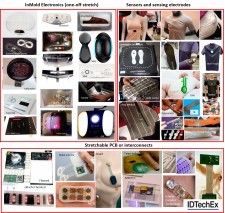
Stretchable electronics (SC) are already commercial and come in many shapes and forms. The panel of images (left) showcases a number of prototypes and products which utilize a stretchable component and/or material. These pictures have been mainly (not entirely) taken by IDTechEx analysts at events around the world during the past five years.
Out of each category in the diagram, multiple products have progressed past prototyping and are already on the market. Indeed, the IDTechEx Research report “Stretchable and Conformal Electronics 2019-2029” finds that the stretchable and conformal electronics market will grow from a small base today to approach $500m within a decade at the level of materials and components. This quoted forecast value includes all the diverse markets which fall under the overarching umbrella term of SCE. The report itself, however, provides market segmentation by application as well as material/component type (14 categories).
InMold Electronics products are beginning to enter the market again, these products rely on the ability of functional materials to undergo a major one-off stretching event. Various fitness products utilizing stretchable conductors as electrodes monitoring the heartrate or as respiratory sensors are already on the market and selling. Similar products are being applied to monitor pregnancy or to monitor the vital signs of animals. Many are also working on stretchable interconnects or printed circuit boards. Here too, a number of products are already on the market.
These cases suggest that most commercial growth comes from the use of relatively simple stretchable electronic elements such as electrodes, circuit lines and interconnects, and basic sensors. As a result, keeping it technologically simple seems to be a prerequisite for success at this phase of technology development. This is despite the fact researchers have demonstrated, at the proof-of-concept or basic demonstrator level, a stretchable version of almost every electronic device, including transistors, displays, batteries, memories, energy harvesters, and so on. For now, however, these complex devices remain very immature.
Setting Up to Identify and Solve Problems
Stretchable electronics face a complicated path to the market; they are not a replacement market in that stretchable electronics will often not substitute an existing component or product. There are rare exceptions, for example, in e-textiles. However, even in those cases, the addressable market itself is nascent and fragmented. As such, the challenge is to create new markets and new demand.
This will require identifying and defining problems, in diverse sectors, which the unique features of stretchable electronics can help solve. This is no easy feat as it requires excellent access and insight to potential end users. This will demand patient and creative end product design around specific challenges. The fact that both (a) new technologies are to be utilized and (b) new customer needs are to be envisioned and created will act as a barrier, prolonging the go-to-market timelines.
This is a major challenge for most conventional firms accustomed to participating in existing and established markets and value chains. It is a particular challenge for the typical organizations that are pushing the development and commercialization of stretchable electronic materials and components/devices. These firms often sit far from end users and do not have the organizational mindset, skillset, or set-up to design, create, and commercialize end products.
This type of challenge is of course not unique to stretchable electronics. IDTechEx Research has observed similar challenges in other emerging technology areas. One example is in printed and flexible electronics. In the earlier days, the vast majority of the market participants were material or component suppliers. The end users who strongly engaged had faced an uphill struggle even to produce low-volume prototypes. They would often have to assemble a small consortium of disparate and small firms with incompatible technologies and unrealistic claims. The path to the market was, therefore, by no means streamlined and the translation of concepts, even when they existed, to marketable products was complicated, time-consuming, and often expensive. This was a damper on the growth prospects and this challenge has taken years to be mitigated. As a result of this challenge, most early successes came not in new product creation, but in successfully replacing a component within an existing product.
The positive side is that the problems to be solved are numerous and exist in every sector. The lowest hanging fruits have so far been in fitness monitoring of persons and animals. InMold Electronics also offers a compelling proposition, despite its production learning curve being rather steep. The next round of products might come in smart skin patches and specialized patient monitoring tools, in protective or AR/VR clothing, and even in specialized textiles for automotive.
The pipeline can be large and robust, but will likely, in the medium term, be composed of many small pieces. As such, companies will need to organize themselves to deal with a multitude of small- to mid-volume products until some blockbuster products emerge and consolidate the landscape. This implies that in the medium the market will remain fragmented in terms of users and use cases, products, value chains, and performance and cost requirements.


