


















 Learning With Leo: Where Reliability Actually Hides
 Knocking Down the Bone Pile: X-ray Inspection of Ball Grid Array Solder Joints





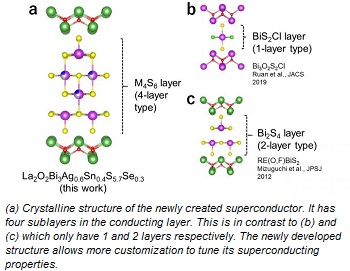
Scientists from Tokyo Metropolitan University have created a new layered superconducting material with a conducting layer made of bismuth, silver, tin, sulfur and selenium. The conducting layer features four distinct sublayers; by introducing more elements, they were able to achieve unparalleled customizability and a higher "critical temperature" below which superconductivity is observed, a key objective of superconductor research. Their design strategy may be applied to engineer new and improved superconducting materials.
Once an academic curiosity, superconductors are now at the cutting edge of real technological innovations. Superconducting magnets are seen in everyday MRI machines, particle accelerators for medical treatments, not to mention the new Chuo Shinkansen maglev train connecting Tokyo to Nagoya currently being built. Recently, a whole new class of "layered" superconducting structures have been studied, consisting of alternate layers of superconducting and insulating two-dimensional crystalline layers. In particular, the customizability of the system has garnered particular interest in light of its potential to create ultra-efficient thermoelectric devices and a whole new class of "high temperature" superconducting materials.
A team led by Associate Professor Yoshikazu Mizuguchi from Tokyo Metropolitan University recently created a bismuth sulfide based layered superconductor; their work has already revealed novel thermoelectric properties and an elevated "critical temperature" below which superconductivity is observed. Now, working with a team from the University of Yamanashi, they have taken a multi-layered version of the system, where the conducting layer consists of four atomic layers, and begun swapping out small proportions of different atomic species to probe how the material changes.
Starting with a conducting layer made of bismuth, silver and sulfur, they tried substituting some of the silver for tin. By varying the amount of silver, they were able to raise the critical temperature from 0.5K to above 2.0K. Interestingly, they found that this was accompanied by the disappearance of an anomaly in its resistivity at significantly higher temperatures. Though the reason behind this is not yet understood, it is clear that the addition of tin has significantly modified the electronic structure of the material. Furthermore, they took their best bismuth, silver, sulfur and tin combination and substituted some of the sulfur for selenium, a modification known to improve superconducting properties in their original bismuth sulfide material. Not only did they raise the critical temperature further to 3.0K, they found that the response to magnetic fields showed signatures of "bulk" superconductivity, providing clear proof that they could in fact access both the advantages of reduced dimensionality and bulk materials.
By changing the composition and number of layers, the team believe they are on the verge of achieving bottom-up engineering of new, tailored bismuth sulfide based superconducting materials.


