










-
- News
- Books
Featured Books
- smt007 Magazine
Latest Issues
Current Issue
Spotlight on North America
A North America spotlight exploring tariffs, reshoring, AI demand, and supply chain challenges. Plus, insights on cybersecurity, workforce development, and the evolving role of U.S. electronics manufacturing.
Wire Harness Solutions
Explore what’s shaping wire harness manufacturing, and how new solutions are helping companies streamline operations and better support EMS providers. Take a closer look at what’s driving the shift.
Spotlight on Europe
As Europe’s defense priorities grow and supply chains are reassessed, industry and policymakers are pushing to rebuild regional capability. This issue explores how Europe is reshaping its electronics ecosystem for a more resilient future.
- Articles
- Columns
- Links
- Media kit
||| MENU - smt007 Magazine
How to Control Friction in Topological Insulators
October 15, 2019 | University of BaselEstimated reading time: 2 minutes
Topological insulators are innovative materials that conduct electricity on the surface, but act as insulators on the inside. Physicists at the University of Basel and the Istanbul Technical University have begun investigating how they react to friction. Their experiment shows that the heat generated through friction is significantly lower than in conventional materials. This is due to a new quantum mechanism, the researchers report in the scientific journal Nature Materials.
Thanks to their unique electrical properties, topological insulators promise many innovations in the electronics and computer industries, as well as in the development of quantum computers. The thin surface layer can conduct electricity almost without resistance, resulting in less heat than traditional materials. This makes them of particular interest for electronic components.
Furthermore, in topological insulators, the electronic friction—i.e. the electron-mediated conversion of electrical energy into heat—can be reduced and controlled. Researchers of the University of Basel, the Swiss Nanoscience Institute (SNI) and the Istanbul Technical University have now been able to experimentally verify and demonstrate exactly how the transition from energy to heat through friction behaves - a process known as dissipation.
Measuring Friction with a Pendulum
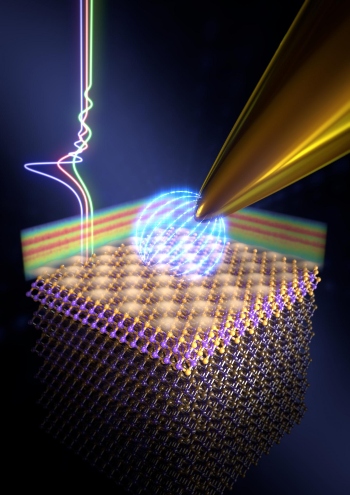
The team headed by Professor Ernst Meyer at the Department of Physics of the University of Basel investigated the effects of friction on the surface of a bismuth telluride topological insulator. The scientists used an atomic force microscope in pendulum mode. Here, the conductive microscope tip made of gold oscillates back and forth just above the two-dimensional surface of the topological insulator. When a voltage is applied to the microscope tip, the movement of the pendulum induces a small electrical current on the surface.
In conventional materials, some of this electrical energy is converted into heat through friction. The result on the conductive surface of the topological insulator looks very different: the loss of energy through the conversion to heat is significantly reduced.
"Our measurements clearly show that at certain voltages there is virtually no heat generation caused by electronic friction," explains Dr. Dilek Yildiz, who carried out this work within the SNI PhD School.
A Novel Mechanism
The researchers were also able to observe for the first time a new quantum-mechanical dissipation mechanism that occurs only at certain voltages. Under these conditions, the electrons migrate from the tip through an intermediate state into the material - similar to the tunneling effect in scanning tunneling microscopes. By regulating the voltage, the scientists were able to influence the dissipation. "These measurements confirm the great potential of topological insulators, since electronic friction can be controlled in a targeted manner," adds Meyer.
Testimonial
"Advertising in PCB007 Magazine has been a great way to showcase our bare board testers to the right audience. The I-Connect007 team makes the process smooth and professional. We’re proud to be featured in such a trusted publication."
Klaus Koziol - atgSuggested Items
I-Connect007 Editor’s Choice: Five Must-Reads for the Week
05/01/2026 | Michelle Te, I-Connect007If it feels like the PCB industry is accelerating faster than ever, you’re not imagining it. From advanced materials driven by AI applications to renewed investment in domestic manufacturing—and the next generation stepping into critical roles—there’s a lot shifting at once. My selections for this week highlight where the pressure points are forming, and where the opportunities are emerging.
Electronics Manufacturing Needs Your Voice: Global Sentiment Survey Now Live
04/30/2026 | Global Electronics AssociationThe latest monthly Global Sentiment Survey from the Global Electronics Association is now open. At a time when demand uncertainty, policy shifts, energy costs, and supply chain recalibration are pulling the industry in multiple directions, the survey captures something macroeconomic data often misses: how manufacturers are actually experiencing conditions on the ground.
From Backbone to Breakthroughs: I-Connect007 Wraps PCB Materials Series with Focus on Innovation
05/04/2026 | I-Connect007I-Connect007 wraps up its six-part podcast series, PCB Materials: The Backbone and Future of Electronics, with Episode 6 and a discussion focusing on innovation. In Episode 6, Marcy LaRont speaks with Isola CTO Kirk Thompson about a critical turning point for the PCB industry as innovation accelerates. As data rates climb and demands from AI infrastructure, power density, flexible electronics, photonics, and chiplet integration intensify, traditional material assumptions are no longer sufficient.
Jiva Soluboard Getting the Attention It Deserves
04/30/2026 | Marcy LaRont, I-Connect007 MagazineJiva is a newer company that bridges the divide between PCB fabrication and product circularity or sustainability. Jiva Soluboard is the first fully recyclable laminate material ever created for PCB fabrication, and it's not going unnoticed. Stephen Driver, CEO of Jiva, gave us an update at APEX EXPO, including an exciting certification achievement in February.
Driving Innovation: Selecting the Right Laser Source
04/28/2026 | Simon Khesin -- Column: Driving InnovationWhen I first joined Schmoll Maschinen, I brought experience from almost every PCB process, except for laser. As I immersed myself in laser processing, I realized why it can seem so daunting to a newcomer. The complexity arises from three intersecting factors: A vast variety of laser sources: CO2, UV-nano, green-pico, UV-pico, IR-pico, and others; a diverse range of applications: Drilling, cutting, ablation, and more; and an extensive list of materials: These have vastly different absorption rates. Choosing the right machine or laser source is rarely trivial. Even for experienced engineers, answering "Which source is best?" requires examining the business's specific goals.