









WAGO Unveils Next Generation I/O System Controller with PROFINET
November 20, 2019 | WAGOEstimated reading time: 1 minute
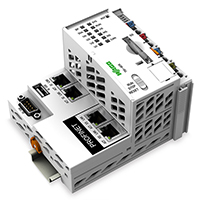
WAGO extends their family of PFC200 Generation 2 controllers with the release of the new 750-8215. The 750-8215 is IIoT-ready, comes with two Ethernet ports, two PROFINET ports, and is programmable with WAGO’s e!COCKPIT software (CODESYS 3.5).
The PROFINET ports are switched for use as a line configuration enabling the controller to function as an I/O device connected to a PROFIBUS master. The two Ethernet ports can be used in a switched configuration or separated, and support other protocols such as EtherCat and Sparkplug (with additional licenses).
Other features of the 705-8215 controller include:
USB-A port with removable memory to extend memory capabilities of the controller
- High Speed processor for complex applications
- Large on-board memory plus SD card slot
- Built-in Web server
- CANopen port allows connection to other devices on a CAN network
This controller can be used for multiple applications and is available now.
For more on the latest from WAGO, visit www.wago.com/us/press-contact
About WAGO
Innovation is at the heart of everything we do at WAGO. From our pioneering CAGE CLAMP® spring pressure connection technology to our extensive range of Interconnect, Interface and Automation solutions, such as the fieldbus independent WAGO-I/O-SYSTEM, our customers count on the unconditional performance and reliability of our products to ensure the safe, efficient operation of their systems every time.
Subscribe
Stay ahead of the technologies shaping the future of electronics with our latest newsletter, Advanced Electronics Packaging Digest. Get expert insights on advanced packaging, materials, and system-level innovation, delivered straight to your inbox.
Subscribe now to stay informed, competitive, and connected.
Suggested Items
I-Connect007 Editor’s Choice: Five Must-Reads for the Week
05/08/2026 | Marcy LaRont, I-Connect007This week, I’ve selected some outstanding interviews that you’ll want to take note of. First, is a roundtable discussion featuring three dynamic industry cybersecurity experts. Please watch this important discussion that affects us all. Following that, I spotlight the IPC-2581 Consortium, which explains why IPC-2581 is the standard to replace Gerber data for manufacturing. Next, I am including my interview with PCBAA and AAM, who collaborated to release a short documentary on U.S. PCB manufacturing.
A Necessary Shift From Gerber to IPC-2581
05/07/2026 | Tracy Riggan, Global Electronics AssociationIPC-2581 is an open, vendor-neutral data exchange standard developed by the Global Electronics Association to streamline the exchange of PCB design information across fabrication, assembly, and test. It replaces multiple legacy formats—including industry standards, Gerber, and ODB++—with a single, comprehensive, XML-based dataset that captures all manufacturing details.
ViaSat-3 F3 Satellite Successfully Launches from Kennedy Space Center
05/04/2026 | BoeingBoeing mission controllers confirmed that the ViaSat-3 F3 (VS-3 F3) satellite is healthy in orbit following its successful launch aboard a SpaceX Falcon Heavy rocket at 10:13 a.m. ET from Kennedy Space Center (KSC) in Florida.
Microchip Expands Post-Quantum Root of Trust Controllers
04/29/2026 | MicrochipAs the industry embarks on the transition to post‑quantum cryptography (PQC), Microchip Technology is expanding its portfolio of Trust Shield, PQC‑ready devices with the TS1800 Platform Root of Trust controller and the TS50x secure boot controller.
Is China Plus One Still Happening in the PCB Industry?
04/28/2026 | Manfred Huschka, Manfred Huschka Management Consulting (Shenzhen) Ltd.For much of the past five years, China Plus One has been shorthand for supply-chain diversification: reducing dependency on mainland China by adding manufacturing capacity elsewhere in Asia. In the PCB industry, however, in early 2026, it is more nuanced. It looks less like a clean geographic shift and more like a layered, capital-intensive rebalancing of global capacity, one that still leaves China deeply embedded at the center.