













-
- News
- Books
Featured Books
- I-Connect007 Magazine
Latest Issues
Current Issue
Beyond the Rulebook
What happens when the rule book is no longer useful, or worse, was never written in the first place? In today’s fast-moving electronics landscape, we’re increasingly asked to design and build what has no precedent, no proven path, and no tidy checklist to follow. This is where “Design for Invention” begins.
March Madness
From the growing role of AI in design tools to the challenge of managing cumulative tolerances, these articles in this issue examine the technical details, design choices, and manufacturing considerations that determine whether a board works as intended.
Looking Forward to APEX EXPO 2026
I-Connect007 Magazine previews APEX EXPO 2026, covering everything from the show floor to the technical conference. For PCB designers, we move past the dreaded auto-router and spotlight AI design tools that actually matter.
- Articles
- Columns
- Links
- Media kit
||| MENU - I-Connect007 Magazine
Candor Industries Enhances Registration Capabilities With Optical Registration
May 24, 2021 | DIS Inc.Estimated reading time: 2 minutes
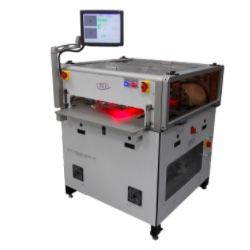
Candor Industries have enhanced their registration capabilities with the addition of a Pin-Less Registration System™ (PRS) developed by DIS, Inc. of Islandia, N.Y. The PRS machine is designed to replace the antiquated and expensive tooling of pin lay-up. Through the use of proprietary Optical Registration™ and SmartWeld™, the PRS aligns and bonds inner-layers and pre-preg, eliminating the need for excess tooling.
A vision and positioning system sequentially align and clamp layers together utilizing a full platen, assuring coplanarity and accuracy. The aligned multi-layers are welded together with SmartWeld™, the patented coupled induction welding system developed by DIS Inc.
In addition, Optical Registration™ provides an opportunity to utilize X-ray inspection to quantify registration of welded multi-layers prior to lamination. The panel can then be measured after lamination, providing the data to analyze the lamination process and take corrective actions if necessary.
The process has been in use worldwide at both high tech and high-volume shops over the past several years. Some of the leading-edge requirements placed on PCB shops utilizing pin technologies are not able to be met unless they introduce Optical Registration.
This year Candor invested US$1.2 million in new technology like Optical Registration by DIS Inc, Induction Lamination Press, Inkjet Soldermask and Idents, Direct Imaging unit. All this new equipment will give them better registration for their Land Less via technology.
About Candor Industries
Candor Industries is one of Canada’s leading environmentally friendly circuit board manufacturers. As the only manufacturer globally to perfect liquid photo-imageable resist (PiP) in electrolytic form, Candor’s panel plating process creates highly uniform surface copper distribution. This leads to excellent impedance matching results, landless via formation and superior fine line features. The PiP process replaces many undesirable products and chemistries from fabrication processes found in the majority of PCB shops around the world. www.candorind.com
About DIS Inc.
DIS Inc. is a worldwide leader in optical registration systems for the printed circuit board industry and an innovative producer of inner-layer/sub-lam registration and welding equipment. DIS has developed Direct Optical Registration™, a new method of optically registering and welding inner-layers/sub-lam such that registration is improved by eliminating mechanical tooling, operational cycle times are reduced and process flexibility is increased all while significantly reducing operating costs. For more information, visit www.distechnology.com.
Testimonial
"In a year when every marketing dollar mattered, I chose to keep I-Connect007 in our 2025 plan. Their commitment to high-quality, insightful content aligns with Koh Young’s values and helps readers navigate a changing industry. "
Brent Fischthal - Koh YoungSuggested Items
SPARK Microsystems Selected for CAD $1M in Government of Canada-backed FABrIC Funding
05/14/2026 | BUSINESS WIRESPARK Microsystems, a Canadian fabless semiconductor company specializing in next-generation short-range wireless communications, has been selected by FABrIC as a CAD $1 million grant recipient funded by the Government of Canada.
System Architecture Beyond the Die With Advanced Packaging as the Scaling Factor
05/14/2026 | Chetan Arvind Patil, Marvell TechnologyIn conventional monolithic semiconductor design, system integration was achieved within a single die and constrained by reticle limits. Compute cores, cache, memory controllers, and input output (I/O) interfaces were all co-optimized on a single process node, with performance closely tied to transistor density and on-die interconnect efficiency. This monolithic system-on-chip (SoC) approach enabled low-latency communication and relatively straightforward power delivery. However, as design for compute-intensive SoCs approaches reticle limits and advanced-node costs increase, the ability to continue scaling within a single die begins to diminish.
Rethinking Reinforcement Materials for Advanced Packaging
05/14/2026 | Ivana Ivanovic, Flexiramics B.V.Materials that once quietly supported the industry are now becoming limiting factors. The electronics industry is experiencing unprecedented pressure as RF systems push into mmWave frequencies, high-speed digital architectures advance into their next performance generation, and power densities climb across automotive, telecom, aerospace, and computing. Reinforcement materials, long treated as a background detail in laminate design, are suddenly at the centre of performance, reliability, and supply‑chain discussions.
Below the Surface: Active Component and Module Submounts—The Architecture Behind Performance
05/14/2026 | Chandra Gupta -- Column: Below the SurfaceIf you were to peel back the layers of a modern electronic system, such as a satellite transceiver, a LiDAR module, or a 5G base station, you would not immediately notice a specific component doing some of the most important work. It doesn’t amplify signals, emit light, or process data, yet without it, none of those functions would be stable, reliable, or scalable. That component is the active device submount.
Road to Reliability: Engineering High Uptime EV Charging Infrastructure
05/13/2026 | Stanton Rak, SF Rak CompanyThe transition to EVs is no longer constrained solely by vehicle capability. Instead, it is increasingly defined by a simpler, but more unforgiving question: Will the charger work when I arrive? This high uptime does not happen by accident. As EV technology has matured, limitations in battery range, power electronics, and thermal management are no longer the primary barriers to adoption.