












 The Fearless Connector: Why I Chose the Hard Road
 The Clean Truth: The Clean Truth About No-Clean Flux
 Global Sourcing Spotlight: Beyond China Plus One—Building a Truly Global Supply Network





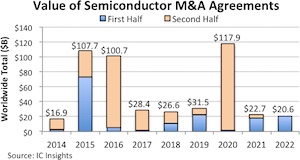
Without more megadeals, this year’s value of planned acquisitions will probably fall short of the annual average, says new update report.
After slowing significantly in the last half of 2021, the pace of megadeals for semiconductor mergers and acquisitions regained momentum in the first six months of 2022, according to M&A data contained in IC Insights’ August 3Q Update of The McClean Report service. So far this year, four large agreements have been announced—each valued between $1.9 billion and $9.4 billion, pushing the combined 1H22 M&A total to $20.6 billion, said the new 3Q Update report.
In comparison, the first-half 2021 total value of M&A agreements for semiconductor companies, assets, product lines, and related business operations totaled $18.2 billion, including four that were announced with price tags between $1.4 billion and $7.1 billion. In the last six months of 2021, the combined value of new semiconductor M&A deals was $4.4 billion—the lowest total for the second half of a year since early last decade, according to the 3Q Update.
The total value of semiconductor acquisition agreements in 2022 appears to be on pace to surpass 2021’s full-year M&A value of $22.7 billion. However, unless significantly more M&A deals are struck in the remainder of 2022, this year’s total value will probably fall below the recent annual norm of about $29 billion (+/- $2 billion), excluding 2020, when acquisition agreements hit a record-high $117.9 billion. The 2020 peak in semiconductor M&A announcements included Advanced Micro Devices’ acquisition of programmable-logic leader Xilinx for stock (initially valued at $35 billion) and Nvidia’s controversial attempt to buy processor-design intellectual property (IP) supplier ARM in the U.K. from Japan’s SoftBank for $40 billion in cash and stock. Nvidia dropped its purchase of ARM in February 2022 after facing opposition by government regulators in the U.S., U.K., and European Union over anti-trust concerns.
The four largest semiconductor acquisition agreements in 1H22 accounted for essentially all of the $20.6 billion in M&A value during the first half of this year, the new update said. Several other smaller semiconductor acquisition agreements were struck in 1H22, but these deals had values under $25 million.
Topping the M&A deals in 1H22 was an agreement by a Chinese investment consortium to take over bankrupt semiconductor conglomerate, Tsinghua Unigroup. The financially troubled company was buried in debt after a decade of acquiring and building up its semiconductor holdings as part of an effort to make China self-sufficient in a number of chip segments and a leading global IC supplier. In April 2022, government-backed Beijing Jianguang Asset Management Co. (JAC Capital) led a group of investment firms to complete a $9.4 billion injection of payments into Tsinghua Unigroup, which runs Yangtze Memory Technologies—China’s first and leading domestic maker of NAND flash memory ICs.
The second largest chip acquisition agreement in 1H22 was Intel’s $5.4 billion deal to buy pure-play wafer foundry Tower Semiconductor in Israel. The cash purchase, announced in February 2022, is expected to be completed by early 2023 and is part of Intel’s push into the silicon foundry business.
In May 2022, California-based MaxLinear announced an agreement to buy Silicon Motion in Taiwan for $3.8 billion in cash and stock. This acquisition is expected to be completed in 1H23 and will add controller ICs for NAND flash storage to MaxLinear’s lineup of RF and mixed-signal products.
AMD, in April 2022, announced a $1.9 billion agreement to buy packet-processor and cloud-computing software startup Pensando Systems in Milpitas, California, to boost its presence in the data center market and increase competition with Intel. The acquisition of Pensando was finished in May 2022; three months after AMD completed its purchase of Xilinx in February 2022. The Xilinx acquisition became the largest semiconductor M&A deal in history because the final acquisition value climbed to $49.8 billion—42% higher than the initial $35 billion estimate when the purchase was announced in October 2020—because of the strong increase in AMD’s stock price during the last two years.


