











 Beyond the Board: How a Diminished Supplier Base Affects Complex PCB Manufacturing Readiness in Defense
 Defense Speak Interpreted: Hypersonics Report Back After Six Years of Silence
 American Made Advocacy: American Microelectronics Power the Future of High Technology





Book Excerpt: 'The Printed Circuit Assembler’s Guide to...Process Control'
July 26, 2023 | I-Connect007Estimated reading time: 2 minutes
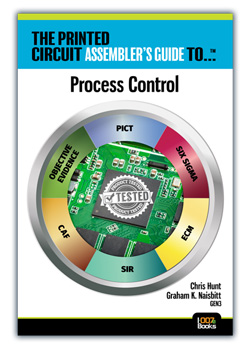
Introduction: The Printed Circuit Assembler’s Guide to...Process Control, a new book from Gen3 Systems.
An electronic assembly, by definition, has a circuit with current flowing. If by corrosion that circuit is changed, open circuit or short circuit, then the assembly will most likely be non-functional and will have failed. Dendrites are fragile metal filaments that can easily fuse when completing a circuit. Hence, an intermittent fault is observed. Continued exposure to the stress environment will cause the dendrite to regrow and cause another fault, and then fuse again. This process can repeat itself many times and, hence, many intermittent faults can be observed. Dendrites are the most common cause of No Fault Found; their intermittent nature tends to allow circuits to perform as normal, with interrupts that are not easily picked up by field return engineers who classify the product as NFF. Only when a dendrite forms a strong permanent short can it be discovered.
Susceptibility to ECM is contingent on harmful residues being present on the circuit assembly, along with other environmental factors. The creation of a water layer is a key step in ECM; this can be a sub-micron adsorbed layer, or a significantly thicker layer caused by condensation.
Figure 2.1: This visualisation (top) depicts condensation on a BGA. Release of organic acids into solution from flux residues (bottom). (Source: Mike Cummings)
Figure 2.1 depicts condensation droplets forming on the top surface of a component. As the condensation builds, at some point it will spill over the edge and then wick under the component. The right-hand images depict a flux residue encapsulating weak organic acids (WOA). When the residue is exposed to water, the WOA will dissolve into the liquid and are then available to support an electrical current. Figure 2.2 shows schematically the chemical processes occurring in ECM.
Figure 2.2: ECM processes. (Source: Mike Cummings)
Figure 2.2 depicts a condensed water layer under a BGA. Within this layer, WOA ions have been produced from flux residues. These ions migrate to the appropriate electrode supporting current flow. At the anode, anions release their charge where typically a cation is formed—in this case, a charged metallic ion. This is a corrosion process taking place at the anode. The cation migrates to the cathode, where it gives up its charge, depositing as a metal, which commonly grows as a dendrite. The figure also depicts diffusion processes and the creation of a double layer at the cathode.
The challenge, therefore, is to create a test that measures this electrical failure, where the causation has been corrosion. Such a test exists, and is the well-known SIR test, which measures resistance between electrodes. By using a SIR pattern, there is a geometric amplification of the resistance change, as well as an increased opportunity to detect a corrosion event. Within a single test assembly, the SIR test can be easily set up to provide data on specific component types. As we will see, the SIR test is the only test that truly provides objective evidence (OE).
Continue reading this book by visiting our library here.
Share on:


Testimonial
"Your magazines are a great platform for people to exchange knowledge. Thank you for the work that you do."
Simon Khesin - Schmoll MaschinenSuggested Items
Carbice Awarded Multi-Million Dollar U.S. Navy Contract for Thermal Assembly Joint Technology
04/14/2026 | PRNewswireCarbice, a U.S.-based manufacturer and supplier of novel multifunctional assembly joint technologies, has been awarded a multi-million dollar contract by the U.S. Navy's Office of Naval Research.
Solder Paste Innovations for Enhanced Reliability from MacDermid Alpha Electronics Solutions
04/10/2026 | Real Time with... APEX EXPOJason Fullerton of MacDermid Alpha Electronics Solutions discusses innovative alloys like Innolot MXE, low-temperature solder options, and polymer reinforcement strategies. Learn how these solutions address the growing demands of high-performance computing and larger component assemblies, ensuring optimal performance and cost-effectiveness.
Frank Sommer Discusses Selective Soldering Innovations for EVs
04/10/2026 | Real Time with... APEX EXPODan Beaulieu sits down with Frank Sommer, a selective soldering expert from Nordson Electronics Solutions, to discuss the resurgence of selective soldering driven by electric vehicle manufacturing, and the need for robust through-hole component integration. He also introduces Nordson's innovative SELECT Synchro selective soldering machine, designed for enhanced throughput and flexibility.
Future-proof Laser Depaneling for PCBs with Photonics
04/10/2026 | Real Time with... APEX EXPOBill Solari of Photonics Systems USA outlines the advantages of laser depaneling for circuit board manufacturing. We learn that this advanced technology addresses rising material costs by increasing panel yield and improving edge quality. This process provides precision, suitability for medical applications, and cost-saving benefits, including the elimination of cleaning steps. There have been significant advancements in laser depaneling, offering a competitive and efficient solution for modern electronics production.
Smarter AOI: Delvitech Brings Native AI to APEX EXPO
04/10/2026 | Real Time with... APEX EXPOMarcy LaRont speaks with Delvitech founder and CEO Roberto Gatti about the company’s AI-native inspection technology and its growing global presence. Gatti explains how Delvitech’s integrated hardware and neural-network–driven platform is unique in the market with unmatched flexibility for implementation across multiple lines and multiple facilities.