














 Global Sourcing Spotlight: Finding Your Greatest Sourcing Asset in Partnerships
 Knocking Down the Bone Pile: Hot Air vs. Infrared PCB Rework
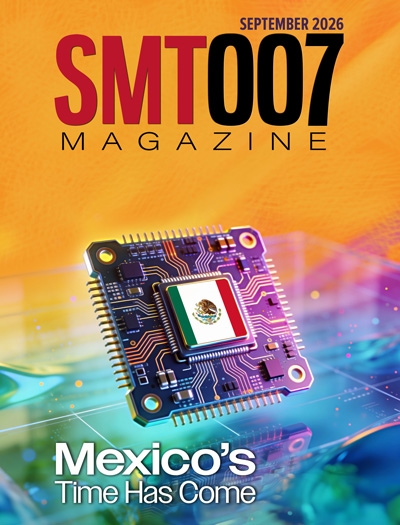
 Nolan’s Notes: Why Mexico’s Time Has Come





My morning in Minneapolis may have started early, with construction workers directly outside my hotel window at 7 a.m., but to me the hustle and bustle was simply a reflection of the activity at SMTA International. The exposition continues its cohabitation this week with MDM&A for one final year, and there was a definite hum in the hall on Tuesday. Eyeballing the attendance, it seems that SMTAI continues its rapid year-on-year recovery from the pandemic effect.
SMTA President Martin Anselm kicked off the Tuesday opening ceremonies with an update on the incoming and outgoing members to the board of directors, and the work each is undertaking. Anselm stressed that SMTA is concentrating on several workforce development programs and technology hubs in collaboration with industry, government, and academia. Sharing the spotlight are SMTA’s online training programs. In addition, Anselm introduced the new corporate membership structure, intended to increase individual use of SMTA services within the corporate environment. The goal, Anselm explains, is to connect more directly to individual users within corporate structure.
Ryan Gamble, CEO and founder of Intraratio Corporation, was the keynote speaker, and he discussed how to make data useful and actionable.
 He noted the drivers pushing us all to actionable data, a critical dependency on electronics leading to higher orders of component integration, reduced lifecycles, needs for higher reliability, supply chain traceability, etc. This is all happening at the same time as talent shortages and the need for knowledge transference. To illustrate his point, Gamble shared an example of how much electrical and electronics debugging the typical auto mechanic does now; even car repair now looks like electrical engineering.
A key part of his talk suggested using open-source software solutions, noting that they dominate the IT environment. Even Amazon’s operations are based on open-source systems: the solutions are accessible, rapidly deployed, easily scaled up, cost effective, no hidden licenses, have huge developer communities, and are very secure on the whole, thanks to these huge communities of users trying to find the exploits.
This open-source strategy will mean hiring software development expertise—either full time or project-based—but the wide user bases for the non-proprietary tools also ensures the ability to find qualified software help whenever needed.
As I visited with exhibitors and attendees throughout the day, enthusiasm was everywhere. Everyone seemed anxious to learn something new and to make a new connection.
We are posting photos and interviews from the exposition. Check out our show site: Real Time with... SMTA International 2023.


