














 American Made Advocacy: American PCBs in Big Demand and Short Supply
 Defense Speak Interpreted: Will Defense Become a Totally New Supplier for Drone Electronics?
 The Right Approach: The End of an Era—DoD Proposes MIL-PRF-31032 Cancellation





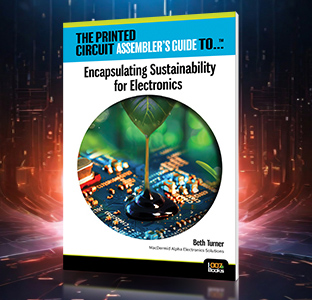
The Printed Circuit Assembler’s Guide to... Encapsulating Sustainability for Electronics, by Beth Turner, MacDermid Alpha Electronics Solutions
Chapter 1: What Are Encapsulation Resins, and Why Do We Use Them?
The terms potting and encapsulation resins are interchangeable. The terms are interpreted slightly differently depending on the industry or organization. Potting sometimes refers to the process of filling housing; the housing forms an integral part of the finished component. The container sometimes functions as a temporary mold to contain the liquid until sufficiently gelled or cured. Then it is removed from the finished assembly. A container or pot is not always required. The rheology of some materials means selective application is possible; this is often referred to as “glob top” application. Some organizations use the word potting to describe the liquid material, and encapsulation to describe the application process and subsequent cure conditions to form the end ruggedizing material.
The end goal of encapsulation is to form a complete, thick barrier, ensuring that printed circuit boards (PCBs) and other electronic components are sufficiently “encapsulated” to survive in the harshest conditions. The primary function is the barrier property: preventing moisture and other contaminants causing current leakage and short circuits, inhibiting corrosion, preventing arcing and corona in high voltage applications, and mitigating against tin whiskers. They can also deliver other secondary value-added functions: mechanically supporting to prevent damage from shock and vibration, delivering flame retardant properties, and dissipating heat away from hard-working components.


