













-
- News
- Books
Featured Books
- I-Connect007 Magazine
Latest Issues
Current Issue
Signal Integrity & Metallization
Signal integrity and additive manufacturing, particularly metallization, are hot topics in PCB design and fabrication. PCB layouts are carefully engineered to achieve specific electrical and power performance targets.
Beyond the Rulebook
What happens when the rule book is no longer useful, or worse, was never written in the first place? In today’s fast-moving electronics landscape, we’re increasingly asked to design and build what has no precedent, no proven path, and no tidy checklist to follow. This is where “Design for Invention” begins.
March Madness
From the growing role of AI in design tools to the challenge of managing cumulative tolerances, these articles in this issue examine the technical details, design choices, and manufacturing considerations that determine whether a board works as intended.
- Articles
- Columns
- Links
- Media kit
||| MENU - I-Connect007 Magazine
Extended NextPower 80/100V MOSFET Portfolio from Nexperia Offers Increased Design Flexibility
August 6, 2024 | NexperiaEstimated reading time: 1 minute
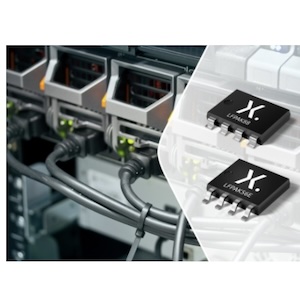
Nexperia announced that the ongoing expansion of its NextPower 80 V and 100 V MOSFET portfolio is continuing apace with the release of several new LFPAK devices in industry-standard 5x6 mm and 8x8 mm footprints. These new NextPower 80/100 V MOSFETs are optimized for low (RDSon) and low Qrr, to deliver high efficiency and low spiking in applications including servers, power supplies, fast chargers and USB-PD as well as for a wide range of telecommunications, motor control and other industrial equipment. Designers can choose from a range of 80 V and 100 V devices, with (RDSon) from 1.8 mΩ to 15 mΩ.
Many MOSFET manufacturers focus on achieving high efficiency through low QG(tot) and low QGD, when benchmarking the switching performance of their devices against alternative offerings. However, through extensive research, Nexperia has identified Qrr as being even just as important due to its impact on spiking and, in turn, the amount of electromagnetic interference (EMI) generated during device switching. By focusing on this parameter, Nexperia has considerably reduced the level of spiking produced by its NextPower 80/100 V MOSFETs and hence also lowered the amount of EMI they produce. This brings significant benefits for end users by reducing the probability of a costly late-stage redesign to include additional external components if their application fails electromagnetic compatibility (EMC) testing.
The on-resistance (RDSon) of these new MOSFETs has been reduced by up to 31% compared to currently available devices. Nexperia also plans to further strengthen its NextPower 80/100 V portfolio later this year with the release of an additional LFPAK88 MOSFET offering RDS(on) down to 1.2 mΩ @ 80 V, as well as introducing the power dense CCPAK1212 to the portfolio. To further support design-in and qualification of these devices, Nexperia offers the availability of award-winning interactive datasheets, providing engineers with comprehensive and user-friendly insights into device behavior.
Testimonial
"Your magazines are a great platform for people to exchange knowledge. Thank you for the work that you do."
Simon Khesin - Schmoll MaschinenSuggested Items
Punching Out: How Are the Big Boys in Electronics Doing?
05/12/2026 | Tom Kastner -- Column: Punching Out!Let’s see what the public companies are up to in the PCB and EMS industries. In North America, there are only a couple of publicly traded PCB companies: TTM Technologies and Firan Technology Group. On the EMS side, there are a few more: Flex, Jabil, Celestica, Sanmina,, Benchmark, Fabrinet, Kimball Electronics, Plexus Corp, Nortech Systems, and Key Tronic Corp. From an M&A standpoint, these public companies have been fairly quiet in the past five years. FTG completed two deals in 2022 (IMI and Holaday), Flex had three deals, Jabil had five deals, and Sanmina had one deal.
I-Connect007 Editor’s Choice: Five Must-Reads for the Week
05/08/2026 | Marcy LaRont, I-Connect007This week, I’ve selected some outstanding interviews that you’ll want to take note of. First, is a roundtable discussion featuring three dynamic industry cybersecurity experts. Please watch this important discussion that affects us all. Following that, I spotlight the IPC-2581 Consortium, which explains why IPC-2581 is the standard to replace Gerber data for manufacturing. Next, I am including my interview with PCBAA and AAM, who collaborated to release a short documentary on U.S. PCB manufacturing.
A Necessary Shift From Gerber to IPC-2581
05/07/2026 | Tracy Riggan, Global Electronics AssociationIPC-2581 is an open, vendor-neutral data exchange standard developed by the Global Electronics Association to streamline the exchange of PCB design information across fabrication, assembly, and test. It replaces multiple legacy formats—including industry standards, Gerber, and ODB++—with a single, comprehensive, XML-based dataset that captures all manufacturing details.
ViaSat-3 F3 Satellite Successfully Launches from Kennedy Space Center
05/04/2026 | BoeingBoeing mission controllers confirmed that the ViaSat-3 F3 (VS-3 F3) satellite is healthy in orbit following its successful launch aboard a SpaceX Falcon Heavy rocket at 10:13 a.m. ET from Kennedy Space Center (KSC) in Florida.
Microchip Expands Post-Quantum Root of Trust Controllers
04/29/2026 | MicrochipAs the industry embarks on the transition to post‑quantum cryptography (PQC), Microchip Technology is expanding its portfolio of Trust Shield, PQC‑ready devices with the TS1800 Platform Root of Trust controller and the TS50x secure boot controller.