








-
- News
- Books
Featured Books
- I-Connect007 Magazine
Latest Issues
Current Issue
Beyond the Rulebook
What happens when the rule book is no longer useful, or worse, was never written in the first place? In today’s fast-moving electronics landscape, we’re increasingly asked to design and build what has no precedent, no proven path, and no tidy checklist to follow. This is where “Design for Invention” begins.
March Madness
From the growing role of AI in design tools to the challenge of managing cumulative tolerances, these articles in this issue examine the technical details, design choices, and manufacturing considerations that determine whether a board works as intended.
Looking Forward to APEX EXPO 2026
I-Connect007 Magazine previews APEX EXPO 2026, covering everything from the show floor to the technical conference. For PCB designers, we move past the dreaded auto-router and spotlight AI design tools that actually matter.
- Articles
- Columns
- Links
- Media kit
||| MENU - I-Connect007 Magazine
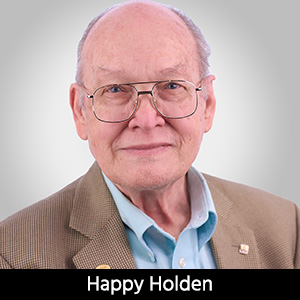
Happy Holden: How I Became an Engineer
February 11, 2025 | Marcy LaRont, PCB007 MagazineEstimated reading time: 2 minutes
What drives someone to become an engineer, particularly a PCB engineer? For industry icon Happy Holden, it was growing up in a family that couldn’t afford a TV but that lived close to a library and a movie theater. It allowed a curious boy the time and space to entertain his interests in science fiction and take things apart to see how the world really worked. As we guide and mentor today’s and future generations, his counsel is definitely worth considering.
Marcy LaRont: Happy, you’ve been in the industry for more than 50 years. How did you become an engineer?
Happy Holden: In the simplest sense, it boils down to toys, time, and money. I wanted toys to play with, my family did not have much money, and I had a lot of time on my hands. Neither of my parents were scientists or engineers. My father was a dairy farmer in Wisconsin and attending UW-Whitewater on the GI Bill. My mother was a farmer’s wife, but worked as a chemist on the Manhattan Project. She had also been an AAU swim champion, so she appreciated sportsmanship and hard work.
When I was young, we didn’t have a TV, so I was left to my own devices to entertain myself. I would often build my toys as the store versions were too expensive. Even for model airplanes, the plastic kits cost too much, so I bought inexpensive balsa wood and paper plane kits which took a lot of time and skill to build. With rubber bands, they could actually fly. Of course, I added a JetEx miniature solid fuel rocket motor to give them power.
We did have a radio, and I enjoyed listening to those programs. I was a builder from my earliest days, and I eventually built a radio receiver. I was someone who wanted to know how things worked. I enjoyed taking things apart and putting them back together.
Read this entire article, which appeared in the January 2025 issue of PCB007 Magazine.
Testimonial
"Your magazines are a great platform for people to exchange knowledge. Thank you for the work that you do."
Simon Khesin - Schmoll MaschinenSuggested Items
Hall of Fame Spotlight Series: Highlighting Karen McConnell
05/07/2026 | Dan Feinberg, I-Connect007In 2021, Karen McConnell was awarded the Raymond E. Pritchard Hall of Fame award in recognition of her contributions to the Association and the electronics industry. As a senior staff member and CAD/CAM engineer at Northrop Grumman Enterprise Services, her primary responsibility was to develop a common, shared EDM (Electronic Document Management) library to support the electrical and PCB design tool initiatives across Northrop Grumman Mission Systems.
A Necessary Shift From Gerber to IPC-2581
05/07/2026 | Tracy Riggan, Global Electronics AssociationIPC-2581 is an open, vendor-neutral data exchange standard developed by the Global Electronics Association to streamline the exchange of PCB design information across fabrication, assembly, and test. It replaces multiple legacy formats—including industry standards, Gerber, and ODB++—with a single, comprehensive, XML-based dataset that captures all manufacturing details.
When Quality Is Personal: The Human Stakes Behind Electronics Reliability
05/06/2026 | Kelly DackIn electronics manufacturing, quality is often discussed in terms of specifications, standards, and process controls, but as industry veteran Doug Pauls reminds us, the stakes are far more human. In this conversation, Doug, a recipient of the Global Electronics Association’s Hall of Fame Award, draws on more than four decades of experience to illuminate the real-world consequences of reliability, where even a single defect can carry profound implications. He brings into sharp focus why quality isn’t just a metric, but a responsibility shared by everyone on the manufacturing floor.
PCBAA, AAM Take on the Fight to Rebuild U.S. Manufacturing in New Documentary
05/05/2026 | Marcy LaRont, I-Connect007Throughout most of the 20th century, manufacturing was central to the American Dream of providing stable jobs and pathways to upward mobility. Today, more than 80% of global electronics manufacturing capacity resides in China and greater Asia, raising serious concerns about supply chain resilience and national security.
Vern Solberg: A Designer's Focus on High Density
04/30/2026 | Marcy LaRont, I-Connect007 MagazineVern Solberg is a distinguished member of the Global Electronics Association Raymond E. Pritchard Hall of Fame and has served as chair or vice chair of many committees, developing technical standards and implementation guidelines, including the IPC-7090 series, which focuses on design for manufacturing and reliability for electronic assemblies. He’s a long-time contributor to Design007 Magazine, and he conducted a half-day tutorial at APEX EXPO 2026, where he addressed 2D, 2.5D, and 3D packaging and ultra-high density hybrid bond interconnect. I caught up with Vern at the show and asked about his pivot from addressing more standard design challenges to his focus on high-density circuits.