












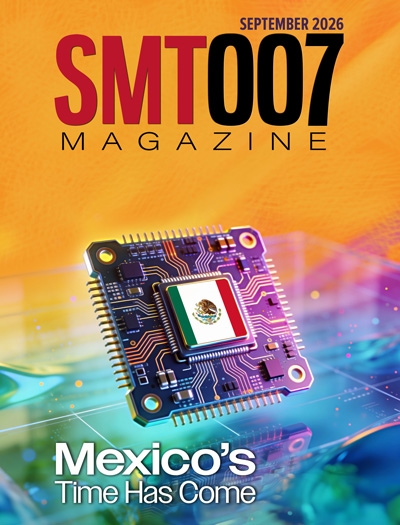


 Bridging the Pacific: What American and Asian PCB Companies Can Learn From Each Other
 Learning With Leo: The Study of Listening
 Nolan’s Notes: Automotive Is Gearing Up Again






Factory of the Future represents a revolutionary shift in electronics manufacturing, aligning the industry's processes with the demands of efficiency, innovation, and sustainability. With challenges such as rapid product lifecycles, stringent quality requirements, and increasing emphasis on environmental responsibility, stakeholders across the supply chain—OEMs, EMS providers, and PCB manufacturers—face mounting pressure to modernize their operations.
IPC standards task groups are at the forefront of this transformation, driven by a set of core principles that guide the transition to a digitally integrated, automated, and secure manufacturing environment.
These task groups are guided by six foundational principles: automation, transparency, seamless integration, ease of deployment, user-friendly operations, and robust cybersecurity. By developing standards guided by these principles, these groups aim to ensure their standards enable any company, large or small, to optimize production, enhance traceability, and address the challenges of real-time data flow, IT-OT convergence, and secure data exchanges across the supply chain.
The foundation of these standards activities has been set through established standards such as IPC-CFX, Connected Factory Exchange, and IPC-HERMES-9852. These standards were instrumental in setting a vision to facilitate ease of adoption within factories and enable interoperability between machines and systems. Over the past several years, additional working groups have developed standards to support traceability (IPC-1782), digital twin (IPC-2551), model-based definitions (IPC/DAC-2552), and cybersecure operations (IPC-1792).
To read this entire article, which appeared in the March 2025 issue of SMT007 Magazine, click here.


