













 Powering the Future: From Substrate to System—The Power Module Assembly
 Global Sourcing Spotlight: Global Sourcing in the Age of Constant Uncertainty
  Nolan’s Notes: The CMMC Certification Question Mark





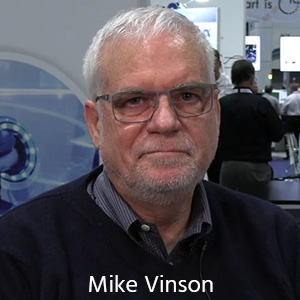
Electroninks, a prominent player in particle-free conductive inks, recently announced an exciting new range of metal-complex inks for ultra high density interconnect (UHDI) technology. At the SMTA UHDI Symposium in January, Mike Vinson, COO of Electroninks, gave a presentation on this line of MOD inks, which are versatile and suitable for a range of applications that require ultra-dense, miniaturized, and high-frequency technology. Mike says his technology is a game changer and will revolutionize UHDI circuit fabrication.
Marcy LaRont: Mike, would you give me a summary of your presentation at the SMTA UHDI symposium?
Mike Vinson: UHDI technology is crucial for developing smaller, more powerful electronic devices. However, its widespread adoption faces several challenges. Our line of products has been developed to address some of these key challenges. Our metal-complex inks simplify manufacturing while improving performance and reliability. We absolutely believe that these materials are poised to redefine how UHDI circuits are fabricated.
LaRont: Please explain what MOD stands for, how it works, and why this is a superior process.
Vinson: MOD is an acronym for metal-organic decomposition. MOD ink is particle-free, unlike the more standard nano-particle-based inks. Being particle-free gets you away from agglomeration, thus ensuring more uniform conductivity. From a processing standpoint, it is versatile for fabricators because multiple deposition methods can be used with it, including inkjet, screen printing, and spray coating. It has a very high peel strength and performs exceptionally well in extreme conditions and environments, and the process itself eliminates a lot of liquid waste. We call it eco-friendly manufacturing.
LaRont: Tell me about your proprietary iSAP process, another part of Electronink’s additive manufacturing solution.
Vinson: This ink-based semi-additive process (iSAP) is an innovative alternative to conventional subtractive etching and electroless plating. The main benefit of this process to fabricators is that, by leveraging MOD inks as a seed layer, iSAP offers a lower overall cost to manufacture. It eliminates process steps, while also significantly reducing waste and power usage compared to traditional etching. It also allows the fabricator to achieve those very fine lines and features required with UHDI, and improves signal integrity and RF performance in high frequency circuits. We believe that iSAP is a true game changer in the landscape of building UHDI circuits.
To read this entire conversation, which appeared in the March 2025 issue of PCB007 Magazine, click here.


