













-
- News
- Books
Featured Books
- I-Connect007 Magazine
Latest Issues
Current Issue
Signal Integrity & Metallization
Signal integrity and additive manufacturing, particularly metallization, are hot topics in PCB design and fabrication. PCB layouts are carefully engineered to achieve specific electrical and power performance targets.
Beyond the Rulebook
What happens when the rule book is no longer useful, or worse, was never written in the first place? In today’s fast-moving electronics landscape, we’re increasingly asked to design and build what has no precedent, no proven path, and no tidy checklist to follow. This is where “Design for Invention” begins.
March Madness
From the growing role of AI in design tools to the challenge of managing cumulative tolerances, these articles in this issue examine the technical details, design choices, and manufacturing considerations that determine whether a board works as intended.
- Articles
- Columns
- Links
- Media kit
||| MENU - I-Connect007 Magazine
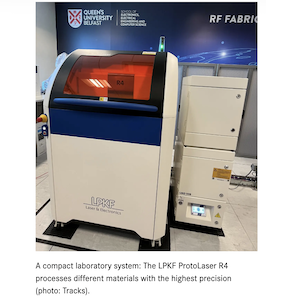
Queen's University Belfast Enhances RF Research with LPKF ProtoLaser R4
March 26, 2025 | LPKFEstimated reading time: 2 minutes
The Centre for Wireless Innovation (CWI) at Queen's University Belfast relies on the state-of-the-art LPKF ProtoLaser R4 to conduct RF research with high-precision structuring of sensitive materials.
Queen 's University Belfast is a Russell Group university. Its Centre for Wireless Innovation was ranked among the top 100 universities in the world in the field of "Telecommunications Engineering" according to the Shanghai Ranking 2024. The university has a proud history of innovative, high-impact and world-leading research.
Queen 's University Belfast expanded its spectrum: It chose the LPKF ProtoLaser R4 due to its performance, flexibility, compact design and ease of use and is using it for its intensive research into future RF technologies.
The LPKF ProtoLaser R4 is designed as a highly specialized precision system with a picosecond laser for research and development laboratories. The ultrashort pulse laser in the compact laboratory device can precisely cut and structure both thermally sensitive and very thin materials with excellent results as well.
The flexibility of the system depends on the combination of laser power, laser frequency and travel speed. When "pumping", the laser energy builds up and is released with a ultra-short pulse. At the lowest repetition rate, the pumping time is longest, then the individual pulse delivers an energy of up to 80 µJ. At higher frequencies and limited laser power, the pulse energy can be precisely limited to less than 1 µJ. LPKF ProtoLaser R4 works with a pulse length of 1.5 picoseconds and a repetition rate between 50 kHz and 500 kHz.
The ultra-short pulse length means that the energy is only effective in the material hit and not in the surrounding area. This bandwidth in combination with stabilized laser energy and the movement of the laser beam enables the ProtoLaser R4 to precisely process robust ceramics such as Al2O3, AlN , SiN , GaN , sensitive two-dimensional graphene or thin films on carrier materials. The ProtoLaser R4 can also remove metal layers from plastic films (e.g. DuPont ME614 on PC) and structure other materials used in the electronics industry, from FR4 to fired ceramics.
Thermal limitation is crucial for both cutting and surface finishing of temperature-sensitive materials. For example, the laser cuts ceramic materials such as Al2O3 or GaN with high energy without discoloring the material edges during the processing process. Thanks to the low heat transfer to the environment, no microcracks occur.
In close cooperation with Tracks Laser & Electronics Ltd, the LPKF distributor in Great Britain and Ireland, Queen 's University Belfast was able to quickly integrate the LPKF ProtoLaser R4 into the RF fabrication laboratory. Other components from the LPKF prototyping series already support rapid in-house prototyping. With these systems, researchers and students develop skills that are essential for rapid technological change.
Testimonial
"We’re proud to call I-Connect007 a trusted partner. Their innovative approach and industry insight made our podcast collaboration a success by connecting us with the right audience and delivering real results."
Julia McCaffrey - NCAB GroupSuggested Items
LPKF Gets Off to a Solid Start in 2026
05/04/2026 | LPKFLPKF Laser & Electronics SE has made a solid start to the 2026 financial year despite a macroeconomic environment that remains challenging.
Driving Innovation: Selecting the Right Laser Source
04/28/2026 | Simon Khesin -- Column: Driving InnovationWhen I first joined Schmoll Maschinen, I brought experience from almost every PCB process, except for laser. As I immersed myself in laser processing, I realized why it can seem so daunting to a newcomer. The complexity arises from three intersecting factors: A vast variety of laser sources: CO2, UV-nano, green-pico, UV-pico, IR-pico, and others; a diverse range of applications: Drilling, cutting, ablation, and more; and an extensive list of materials: These have vastly different absorption rates. Choosing the right machine or laser source is rarely trivial. Even for experienced engineers, answering "Which source is best?" requires examining the business's specific goals.
AI, HDI, and Interconnect Optimization with MKS' ESI
04/23/2026 | Real Time with... APEX EXPOThis discussion revolves around the transformative impact of AI on HDI and substrate manufacturing. Casey Krueger explains the company's "Optimize the Interconnect" initiative, which features Atotech, to provide a comprehensive solution from pretreatment to laser drilling. MKS' ESI offers the innovative Geode G2 platform which is an advanced laser drilling technology that enhances productivity, reduces energy consumption, and addresses complex design challenges in processing both PCB and ICP materials.
Horizon Sales Adds LPKF Laser and Electronics to Its Lineup
04/21/2026 | Horizon SalesHorizon Sales, a leading manufacturers’ representative and distributor to the electronics industry, is pleased to announce a new partnership with LPKF Laser and Electronics, a global leader in precision laser technology
Future-proof Laser Depaneling for PCBs with Photonics
04/10/2026 | Real Time with... APEX EXPOBill Solari of Photonics Systems USA outlines the advantages of laser depaneling for circuit board manufacturing. We learn that this advanced technology addresses rising material costs by increasing panel yield and improving edge quality. This process provides precision, suitability for medical applications, and cost-saving benefits, including the elimination of cleaning steps. There have been significant advancements in laser depaneling, offering a competitive and efficient solution for modern electronics production.