












 Knocking Down the Bone Pile: Hot Air vs. Infrared PCB Rework
 Nolan’s Notes: Why Mexico’s Time Has Come
 Standard of Excellence: ‘Quality’ Is Your Company's Greatest Competitive Advantage





While many universities struggle to keep their curriculum up to date with the evolving needs of the electronics industry, the University of Arizona stands head and shoulders above the others. Its Center for Semiconductor Manufacturing incorporates five of the colleges at UA and emphasizes an interdisciplinary approach to prepare students for diverse careers in technology and manufacturing.
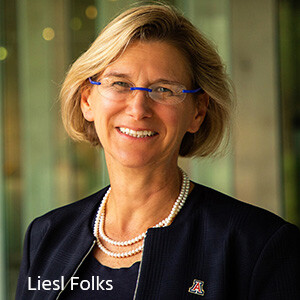
As part of the IMAPS show in Phoenix, we learned more about the university’s initiatives to focus on hands-on learning experiences, research opportunities, and industry collaborations. I met with Dr. Liesl Folks, the center's founder, to learn more about how the center might benefit the entire value chain beyond semiconductors.
Marcy LaRont: Liesl, it is nice to meet you. Why was this center first established?
Liesl Folks: In 2023, we established the Center for Semiconductor Manufacturing at the University of Arizona to support the expansion of semiconductor manufacturing in Arizona and across the nation through research and development services and workforce development activities.
On the workforce side, we're offering programs that start in middle schools and continue through to adult education. We're very excited to launch the nation's first career and technical education (CTE) program in semiconductor manufacturing for high school students in 2025, in partnership with Chandler Unified School District.
LaRont: My son went to Chandler Unified. It has some some great schools that specialize in the sciences as well.
Folks: Yes. We are currently ordering equipment, developing curriculum, and building it all digitally to share it with other interested school districts as soon as we've got it up and running.
Of course, we've also developed all kinds of programming for university students, and we're partnering with community colleges and industry to ensure that all of it is industry-informed. We're especially excited to include semiconductor packaging, too. The explosion of new and exciting advanced test and packaging processes is really interesting, and we hope there'll be loads of interesting careers for students in that space.
LaRont: How do you incorporate all the colleges and disciplines within the university?
Folks: As we developed the center and considered how to coordinate the university's response, we knew we wanted to touch the whole value chain for semiconductor manufacturing because so much of it is important to Arizona. We wanted to support all parts of the sector, from the materials and minerals that need to come into the pipeline for manufacturing to business analytics and distribution systems.
Within the Center, we have involved five of UA’s colleges: Eller College of Management, the Wyant College of Optical Sciences, the College of Science, the College of Engineering, and the College of Applied Science and Technology, which brings cybersecurity to the table, including for hardware systems. They're all important to the landscape right now. So, we have five colleges all coming together to determine how we best support R&D and workforce development for the sector.
LaRont: I understand you also have a cleanroom-type lab environment for prototyping?
Folks: We're really grateful to the Arizona Commerce Authority for giving us funds specifically to renovate our main cleanroom for doing nanofabrication and microfabrication of devices.
That's happening now. We won't be into our new space until early next year, but it's great to see that project underway.
We also have a separate cleanroom for doing integrated photonics devices, and that is unusual for a university.
Finally, we have another cleanroom for integrating packaging products, and, interestingly, this history is rooted in our work in astronomy. We have built exquisite sensors for both ground—and space-based astronomy. Because of that, we had to have a cleanroom environment for full-stack packaging and integrating silicon chips with these sensor systems.
So, we are able to do heterogeneous integration in our own cleanroom facility, using structured wafers and bringing them all the way up to finished products that we ship. We do a lot of work with the space sector, building small numbers of components that are radiation hard, for example, and getting them out to customers who then fly them in space.
LaRont: Is that a privatized part of UA or are those grad students and PhD students?
Folks: That lab is run by staff scientists who do an amazing job. It's not a research facility, and we often handle ITAR-control devices in that space, so it is not a student-facing facility. It supports our research enterprise and also supports industry with this particular skill set and tool set.
LaRont: Liesl, how does this distinguish the University of Arizona?
Folks: As far as we can tell, we may be the only university that has a full packaging line that is able to produce these heterogeneous integrated products and ship them to customers. In my research, I haven't found another university that can build and ship heterogeneous products. It's an unusual feature of our university.
LaRont: Do you find that even though this is a very specific and focused training for students, that this type of exposure will also filter down to other areas that aren't specifically semiconductor manufacturing?
Folks: Yes, we have very intentionally determined that all our training will open student’s eyes to potential careers across the value chain, and that students will be given transferable skills that carry over to STEM-centric industry sectors.
Everything we're doing has a strong underpinning of basic science, applied math, and critical reasoning skills, so that even if we are specifically talking about semiconductor manufacturing, students will have a skill set they can take with them into other parts of the economy. We're incorporating an understanding of the entire global ecosystem for semiconductor supply. We want them to understand and be able to interpret the macroeconomic landscape for the environment they'll be working in.
LaRont: That is very good news. Liesl, I so appreciate what you're doing here.
Folks: Thank you, Marcy, for the opportunity


